
Solo exhibition by Justian Jafin W.
BARA BEKU – TETES TANDUS
(Of Family and the Waves of Changes as Recorded by Justian Jafin)
A Note: Suwarno Wisetrotomo
Justian Jafin is looking mellow, and perhaps even worried. As a husband and father for his children, in the midst of the shifting of social, political, economy, technology and the flash flood of information, and not to mention climate and environmental crisis, had brought him more realization how the challenges of the future is getting increasingly more complex. Worrying about the future of the children, especially for parents, is a common thing to happen. However, feeling anxious alone would not suffice, it is better to be actively anticipative; how to plan out the preparation of a safety belt to face and tackle the problems. What did Jafin do?
As a painter, Jafin recorded, narrated, and shared his anxieties and hopes through paintings. When his artworks are exhibited in several galleries, or a number of art events, Jafin had sent out a hidden message. He created a condition: touched or untouched, comprehending or missing the point. The created condition can go beyond his expectation, or the contrary. Whatever condition was created, it was not the benchmarks of success for his artworks. Because that is just the way things are; the audiences are the producer of meanings based on their preferences, references, and experiences.
The crucial part to be understood is the process; how Jafin responded to issues and sent out messages to others, with what method and choice of form. It is the creative process that can be used as an entry-point to enjoy (and even better, to understand) the artworks and messages sent out by Jafin.
He identified the root issues of his anxiety, among others: social relationship and social orders that shifted quickly, system and standards of values that are different and transformed the the ways and models of sesrawungan (Javanese: interactions and encounters), new decisions regarding how one chose their life partners, marrying (or not), having children (or non), including the decision to hold any belief (religion), how to be a member of society, how to practice tolerance, how to look critically at radicalization, et cetera. All of these are referencing to the social media that transforms into a flash flood of information. Jafin also observed the tendency on the reduced number of children all over the world, the crisis of youth in the midst of noisy talks regarding demographic bonus; tendencies of couples to be childless, or same sex parents. All of these demonstrate life with a parameter that is different from before. Suddenly there seemed to be a lot more options, what was once in the grey area or a taboo, becoming clear and out in the open, permissive, as if it became normal. New findings, radicalization happening in a family is much more dangerous than the one happening through social media (Kompas, Saturday, 3 August 2024). These kinds of things, often seems and feels like a turbulency as well as disruption that surprises everyone. What kind of generation that will color, or even be responsible on life in the future.
These issues are intersecting each other in the mind (and in the visual observation) of Jafin, and including all of us. Jafin experiences the struggles of building communications with his wife and children, finding ways to maintain enough space for artistic practices (painting), and how to build networks, seizing presentation spaces as part of, to borrow from Pierre Bourdieu, exchanging "capital". Not easy, but necessary. And then he compares the situations and challenges of the generation of his parents, to his own generation, and to today’s generation. How it becomes even more complex, increasingly difficult, but it has to be faced. From the experience of experiencing, Jafin reviewed and mapped out the issue, that "family" is actually the last bastion where the future generations are prepared. The theme “family” is hope, along with all the ironies and paradoxes that come with it.
“Family” in the Waves of Changes
Jafin’s paintings grabbed our attentions: the colors and sharp, contrasting shapes became a back drop for the figure or family who pose for a photograph. Most of them seemed to have hailed from the middle class, with full attire (the adult women wearing saris, the men wearing full garments, like an Indian family? Why India?). Or at least the photograph could be suspected as a way of presenting themselves in the image of a middle-class family. Isn’t photography with ‘salon’ approach perfectly capable to conjure up reality to appear beautiful?
Jafin’s painting is a configuration between the natural landscape (desert, tropical light, snow; vegetation such as banana trees, cypresses, shrubs, cacti); anonymous figures in formal or stylish poses in the midst of nature; and other related objects. In several paintings, texts were graffitied on the composition. The texts are intended to reinforce the messages that are being conveyed. For example, he scribbled “different land same problem” on a painting titled Different Land (2024); a family poses for a photograph with three children standing in the background. On the faces of those figures were ornaments commonly found on a house supporting beam; posing under the miniature of Javanese traditional house. In the lap of the mother, the tip of a banana tree with lush leaves. Then the surrounding landscape and the mountain far behind, covered in snow, also superimposed the shrubs and cypress trees. The contrasting, at the same time absurd, panorama.
Families live everywhere, built through many ways, one of the normative ways is through an official marriage that provides protection by religion and the state. Planet earth has various conditions, topography, geography, that made it fell under different types of seasons, depending on the hemisphere. All factors and elements will affect all aspects and elements of life. Character, fighting power, life force, habitus, and so on will differ from one land to another; like them (and all living beings including various vegetations) that live in the tropical area, desert area, or the four-seasons countries.
Thus, it so. Basically, families are deep in contemplation with norms that are adjusting, shifting, in tensions, and clashing between the old and the new. How to create a new balance without sacrificing the old system of values that (maybe) have always been relevant as a guidance (e.g. religion, ethics, respect and emotional intelligence), while also being aware of the generational gap. In the midst of that tidal wave of change, interestingly, perhaps even provocatively, Jafin puts “family” as the source of the problems, and at the same time the source of solutions for the problems. Family holds a fundamental position as the basic madrasah (educational medium) that decides the mental, sensitivity, and intellect qualities. In the course of life, the family becomes a shelter (physically and psychologically) as long as the support system is built well.
Jafin’s artworks are certainly not a formulation or answer to this complex matter. On the contrary, Jafin recorded and re-presenting it in the form (and message) related to situations that are contrasting, paradoxical, and at the same time efforts to build defense and resilience. In other words, Jafin’s paintings are visual provocation; at times it weeps, sometimes it’s hilarious, occasionally snarky, sometimes a satire, sometimes a hope.
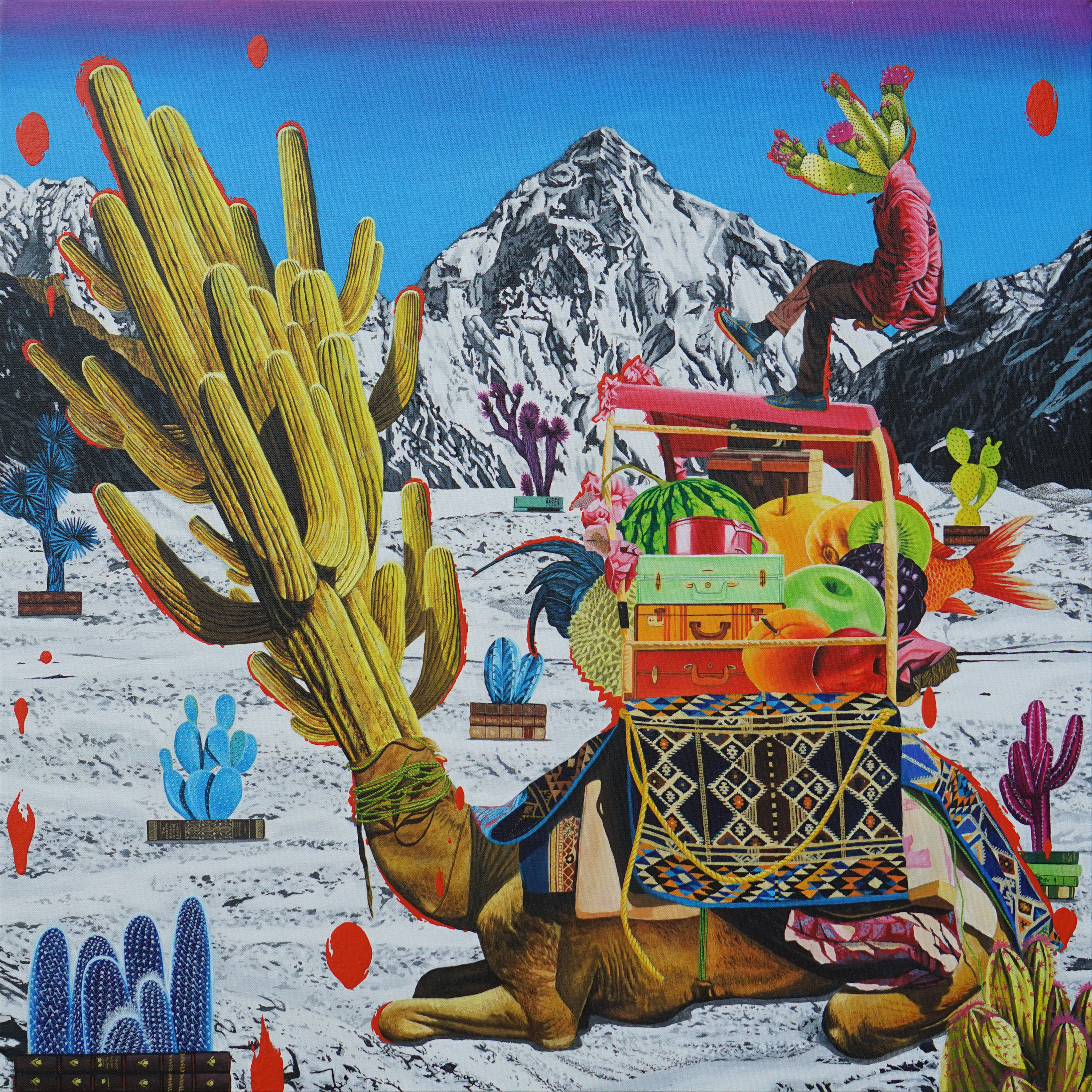
The painting titled Cultural Invasion (2024): An exhausted camel, kneeling in a snowy desert, behind it are mountains also covered in snow. The camel back holds a tower of things, there are fruits, chicken, fish, and even at its head and muzzle is a tall cactus tree. This is how Jafin describes cultural invasion, although the word invasion is now done in a gentle manner, subtle, but the impacts are significant. New traditions (of culture) arrive from all corners of the world, effectively penetrate through the latest technology (smart phone and all its features), has a seductive force that is anesthetizing, repetitive, and addiction inducing. This painting seems to be related to the artworks Tumbuh dan Kembang #1 and Tumbuh dan Kembang #2 (2024): when a cactus tree can thrive in a snowy plane, that it grows colorful blooms, it can be well-assumed that it has acclimatized well. Acclimatization could be understood as acculturation, cultural crossovers, and the likes. Likewise, when an evergreen tree grows in an arid land with solid rocks, yet it can bear colorful flowers, even under snow, it can be well-assumed that it is forced or force itself with adaptation. This is how invasion could be understood, whether it is internalized and forced, coerced, or compelled.
The next paintings highlight classes and the dream of surpassing the current class, just like anyone's dream anywhere: Darah Daging Buah Hati – Mimpi Masyarakat Tropis #1 and Darah Daging Buah Hati – Mimpin Masyarakat Tropis #2 (2024): scenes of a middle-class family photo in a warm room. Fresh fruit (banana, papaya) covers the faces of the children; while the faces of the adults seem to melt. The dream of pleasure for children can be simple. Adults, on the other hand, need extra effort to realize their dreams. If we read into the titles, it is a mirage for an average family, let’s call them the bottom tier, to become a well-established middle-class family with all the facilities and privileges. The painting shows the issue of social class and (food) sovereignty that occurs in any part of the world.
How Jafin processes the issues in his surroundings on contradictions, clashes of cultures and traditions, can be traced for instance in the painting Bara Beku (2024): a landscape full of snow, mountains, and cold-resistant fir trees. The burning fire left behind embers, and a cloud of black smoke rises from a fancy framed family photo. The rising flames and smoke show a trace of colorful rainbow at the edges. There are two figures on the right (blue flame-headed) and left (red flame-headed), both wearing full-suits, playing wind musical instruments. The figure in the middle is wearing a winter coat, has a head of a doll, reading a thick book. The entire scene is set in snow, and even snowballs are falling. Paintings with the same title, Bara Beku (second and third paintings) focuses on the flames and thick smoke, coming from the burning sofa. Around the sofa, objects such as luggage, bags, wrappers, parcels, watermelons, and toys are scattered. The snow drops are no longer white, it’s red. In the third painting, the sofa and the objects in it, all are burning in big fire; the falling snow is in the color of white and red.
In these three paintings, Jafin depicted the panorama of today's world: filled with extreme outbursts of people and events, sharp contrasts, shocking, challenging, as well as creating dynamics, tension, and quite possibly become an exciting new normal. The future generations grow up in such atmosphere, and they would even handle, manage, or lead in a more or less same situations, or perhaps an even more extreme condition. The two Bara Bekus are Jafin’s projections of the current situation and at the same time of the future.
After contemplating with artworks that present the issues, and projections of the issues, Jafin’s next artwork offer you some hopes. The work titled Tetes Tandus (2024) as example: in a desert landscape, or perhaps it could be a tropical landscape, a fire burns but it is small, two figures playing wind instruments seem to be making sounds, while a figure in a thick red jacket with a blue balloon head seems more relaxed. The weeds are growing, some of them dried out. Objects that were scattered (in Bara Beku), seem to multiply in this painting (various fruits, luggage, bags, neat parcels, packages in plastic). In the background we can see the blue sky, and the aspruce tree still full of snow in a fallen position straight to the right. Arid desert, small fires, snow at the far background, all in one atmosphere. Life seems jazzy.
Is Jafin projecting a new order of values and harmony? Reading into the title, Jafin seem to also hope, that the various differences, sharp contrasts, various clashes and tensions, should become a new harmony. A snowdrop on a barren land is a possibility, it will coagulate into an inevitability, therefore hope must be built. Embers ignite, cold freezes, barrenness dries up, drop by drops of kindness are needed to cross-combine them, to create harmony. Although we know, harmony is but a mirage. Therefore, we must continue to strive for it.
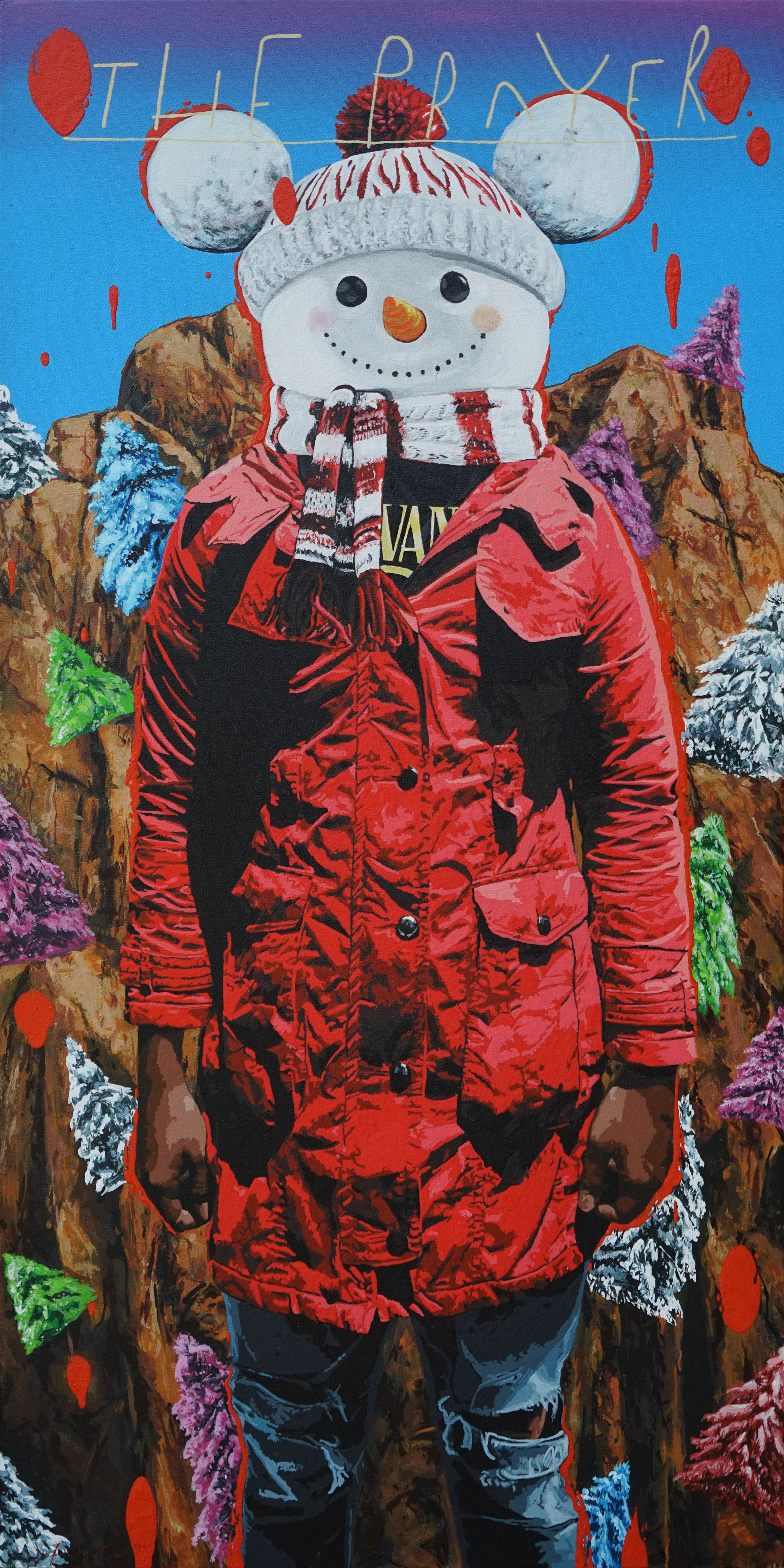
So, who are these figures painted one by one? Jafin seems to draw a close-up of the figures in the “family portrait” in the large-scaled painting. The entire face is not shown; it is positioned in a contrasting space, with realistic depictions of details (mainly the cloth). Each figure is given a marker (title) for the role they play, such as: The Walker, Husband, Boy, Grand Father. Jafin presented his role, which might have meant a lot to him.
Silent Activism
There are many ways (as well as forms) in which art/artworks have the potential to mobilize. The artworks are created by the artist as part of their activism. Jafin’s paintings seem to be in that space: they record, interpret, and experience the turbulent events of today. The result of this recording and contemplating he sent to anyone as a (hidden) message for more contemplation.
The involved art in the context of Jafin is not a loud activism that includes a lot of persons as part of the action, it is but a discreet provocation, oftentimes looking “beautiful”, through his paintings. The message contents being distributed, not only of personal matters, but matters that relate to the masses, that are universal, or even that become public knowledge and phenomenon. For example, as mentioned at the beginning of this article, matters that will always arise such as intergenerational communication when misunderstandings often occur due to the generation gap, parameters of what is considered as conventional are shifting as behavior is influenced by many factors, among others, the opening of networks and the abundance of almost unfiltered information.
Jafin’s anxiety can be seen through his choice of colors, shapes, composition, appropriation, which offers irony, paradox, and sometimes bitterness. These kinds of works became a kind of sign of the times, created by a number of young artists in different variants, (Reminding me to the works of Zico Al Baiquni, Prabu Perdana, Lugas Sylabus, or Aurora Santika, among other names). Although the paintings are colorful, bright, soft, and sometimes sharp, they are not always joyful, but instead have a somber message.
Bara Beku – Tetes Tandus used to frame the solo exhibition of Justian Jafin in Nadi Gallery (20 August–15 September 2024) becomes an expression to send a powerful message to anyone; those involved in the vortex of change, as well as those watching from a distance. There is turbulence, collisions, tension, but also hope. Today we have wide of options to choose from, a strong current of information flows—the fake, the lies, the slander, the deceit, the hoaxes, the fake news, the hate speech, mixed with the genuine, the honest, the one with integrity—merging into one. The world of simulacra is full of traps. “Bara” or the ember is a critical message so we are always careful with the probability of fire that will burn everything; ember that turns things into ash. Whereas “tetes tandus”, the soaking aridness, is a powerful message to melt the frozen, the arid, the rigid, the uncommunicated with clarity. In between the ember and snow lie the formidable deserts and tropics. In the desert cacti grow, in the tropics with two seasons, plants, fruits, live well. Even moss has its uses. Jafin recorded and then presented these contrasting situations in an interesting way; desert landscape, cactus, snowflake, fire, cypress tree, banana tree, bale bengong gazebo, joglo house, suitcase, watermelon, converge in a juxtaposition configuration.
The work of painting is not getting easier today nor tomorrow, if the envisioned outcomes are 'function' and 'influence/impact' for others (audience, audience, art public, or society). Because, while you have to go beyond technicalities and visual goodness, you also have to consider function and impact. Or to borrow a famous exclamation from S. Sudjojono, “truth comes first, beauty follows” (“new art painting”, Sudjojono said, “is not propagating beauty, but propagating the truth to everyone”). On the other hand, if the envisioned achievement is ‘merely' to produce a finished work that is interesting to see, it is most likely that the works will stop at the level of beauty.
Justian Jafin did his best to show through his works that, while having the artistic abilities, he also demonstrates his aesthetic and intellectual tastes. More than just being upset, he also contemplates, worries, and voices out the issues with its excesses and implications, as a message that he sent to the audience. This is why I call it a silent activism.
Yogyakarta, 3 August 2024
Suwarno Wisetrotomo
Lecturer in the Faculty of Fine Art and Design, and in the Postgraduate Programme, ISI, Yogyakarta. Guest lecturer at the Performing and Fine Arts Study Program (PSPSR), Postgraduate Programme, UGM.

Justian Jafin W.
Bara dan Beku, 2024
Acrylic on canvas
150 x 150 cm
Justian Jafin W.
Cultural Invasion, 2024
Acrylic on canvas
100 x 100 cm

Justian Jafin W.
Darah Daging Buah Hati - Mimpi Masyarakat Tropis #01, 2024
Acrylic on canvas
160 x 200 cm

Justian Jafin W.
Darah Daging Buah Hati - Mimpi Masyarakat Tropis #02, 2024
Acrylic on canvas
160 x 200 cm

Justian Jafin W.
Membakar Hujan Salju #01, 2024
Acrylic on canvas
120 x 150 cm

Justian Jafin W.
Membakar Hujan Salju #02, 2024
Acrylic on canvas
120 x 150 cm

Justian Jafin W.
Meski Tak Semanis Permen dan Es Krim #01, 2024
Acrylic on canvas
40 x 30 cm

Justian Jafin W.
Meski Tak Semanis Permen dan Es Krim #02, 2024
Acrylic on canvas
40 x 30 cm

Justian Jafin W.
Meski Tak Semanis Permen dan Es Krim #03, 2024
Acrylic on canvas
40 x 30 cm

Justian Jafin W.
Meski Tak Semanis Permen dan Es Krim #04, 2024
Acrylic on canvas
40 x 30 cm

Justian Jafin W.
Meski Tak Semanis Permen dan Es Krim #05, 2024
Acrylic on canvas
40 x 30 cm

Justian Jafin W.
Meski Tak Semanis Permen dan Es Krim #06, 2024
Acrylic on canvas
40 x 30 cm

Justian Jafin W.
Meski Tak Semanis Permen dan Es Krim #07, 2024
Acrylic on canvas
40 x 30 cm

Justian Jafin W.
Meski Tak Semanis Permen dan Es Krim #08, 2024
Acrylic on canvas
40 x 30 cm

Justian Jafin W.
Meski Tak Semanis Permen dan Es Krim #09, 2024
Acrylic on canvas
40 x 30 cm

Justian Jafin W.
Meski Tak Semanis Permen dan Es Krim #10, 2024
Acrylic on canvas
40 x 30 cm

Justian Jafin W.
Meski Tak Semanis Permen dan Es Krim #11, 2024
Acrylic on canvas
40 x 30 cm

Justian Jafin W.
Meski Tak Semanis Permen dan Es Krim #12, 2024
Acrylic on canvas
40 x 30 cm

Justian Jafin W.
Meski Tak Semanis Permen dan Es Krim #13, 2024
Acrylic on canvas
40 x 30 cm

Justian Jafin W.
Meski Tak Semanis Permen dan Es Krim #14, 2024
Acrylic on canvas
40 x 30 cm

Justian Jafin W.
Meski Tak Semanis Permen dan Es Krim #15, 2024
Acrylic on canvas
40 x 30 cm

Justian Jafin W.
Meski Tak Semanis Permen dan Es Krim #16, 2024
Acrylic on canvas
40 x 30 cm

Justian Jafin W.
Meski Tak Semanis Permen dan Es Krim #17, 2024
Acrylic on canvas
40 x 30 cm

Justian Jafin W.
Meski Tak Semanis Permen dan Es Krim #18, 2024
Acrylic on canvas
40 x 30 cm

Justian Jafin W.
Meski Tak Semanis Permen dan Es Krim #19, 2024
Acrylic on canvas
40 x 30 cm

Justian Jafin W.
Meski Tak Semanis Permen dan Es Krim #20, 2024
Acrylic on canvas
40 x 30 cm

Justian Jafin W.
Meski Tak Semanis Permen dan Es Krim #21, 2024
Acrylic on canvas
40 x 30 cm

Justian Jafin W.
Tetes dan Tandus, 2024
Acrylic on canvas
150 x 150 cm
Justian Jafin W.
The Prayer, 2024
Acrylic on canvas
100 x 50 cm

Justian Jafin W.
The Walker, 2024
Acrylic on canvas
100 x 50 cm

Justian Jafin W.
Tropical Family, Different Land Same Problem #01, 2023
Acrylic on canvas
150 x 150 cm

Justian Jafin W.
Tumbuh dan Kembang #01, 2024
Acrylic on canvas
100 x 100 cm

Justian Jafin W.
Tumbuh dan Kembang #02, 2024
Acrylic on canvas
100 x 100 cm