
03.12.24 — 28.12.24
Manusia Sungai
Solo exhibition by Rizka Azizah Hayati
Download E-Catalogue
RIVER MAN
FROM THE CROCODILE MYTH TO TRACING THE ANCESTRAL LEGACY
PROLOGUE
As one of the curators of ARTJOG, held from July 7th to September 4th 2022 in Jogja National Museum,
I first knew about Rizka Azizah Hayati when her name was included in ARTJOG 2022 artist selection.
ARTJOG 2022 had the theme “Expanding Awareness” as an attempt to expand awareness
and making art more inclusive. Rizka’s Magical Crocodile is an art instalation in the
form of a brown-ish crocodile skeleton, 6 meter in length, displayed on top of a dining table with
white tablecloth. Its tail extends all the way under the table and its head sticking up. Its jaw is
wide open, showing sharp, serrated teeth in its mouth cavity. The skeleton is not made from real
animal bones, it’s made from waste cloth and the brown coloring was from the natural color of
rust.
After the work was completed and moved to ARTJOG exhibition space, I served as a mentor for Rizka,
especially in the matter of display and in activating the audience of her work. The Magical
Crocodile is a tribute for the crocodile as the river protector in Kalimantan, especially in
the Mataraman, Banjar, South Kalimantan, at the shores of Martapura River, where Rizka was born and
raised.
Rizka Azizah Hayati was born in 1996 and raised in Bawahan Pasar village , a small village by the
Martapura river, South Kalimantan, Indonesia. She grew up as a native with strong Banjar customs,
which is a blend of Dayak-Malay cultural acculturation with Islam. Since her childhood, Rizka has
often heard stories about the ceremony of presenting offerings to the “crocodile” that
guards the river. It is from here that she drew the idea to present the audience with a meal on the
dining table next to her crocodile 'statue'. The audience can interact by wearing the head
of the crocodile like a helmet while they ‘taste’ the drinks in the state of relaxation,
which is why there are chairs by the table. It was decided then to use two chairs to seat the
audiences who will interact with the artwork (from the planned four chairs) to give the the space
more legroom and not obstructing the flow of visitors.
When arranging the display for ARTJOG, my conversation with Rizka became more intense as we were
facing the artwork that had already been on display in the space. Our conversation was ranging from
discussing the type of cloth that was being used as material for the crocodile installation, to the
importance of burning incense in the exhibition space, etc. The yellow cloth material, for example,
are often used as marker for sacred places and was obtained from cemeteries not far from her home.
The white cloth was an inheritance from her grandfather, it was used to bathe people in a cleansing
rite. Also used were discarded mukenas and mosquito nets belonging to her grandmother, as well as
other textile materials, utilized as a medium for this installation work. Permission had been
requested for these sacred and history-filled fabrics, and they were allowed to be used as artwork
material before they were sent from Banjar, South Kalimantan, to Jogja. The memories of making
offerings to the river protector were still so vivid in Rizka's memory that she intended to
capture the mythology in the form of art.
The Magical Crocodile work is interesting because Rizka’s direct experience as a young
artist can be interpreted into this work with strong environmental issues. Different from other
young artist who usually highlight an issue before seeking the experience, Rizka started off from
her direct experience, she even had a very intimate memory and the curiosity about the river ritual
culture.
After ARTJOG 2022, my conversations with Rizka were increasingly frequent, she often visited my
studio and discussed the crocodile myth in Martapura or Kalimantan in general. I happened to have
been to Martapura before, so I can imagine the location setting and the river culture in it. The
remainder of our conversations were about her mystical experiences related to one of her ancestors,
and then Rizka began her data research and visited several sites in Martapura (exploring the
Martapura river, museum, the Great Amuntai Temple, etc.).
About five months ago, Rizka began to talk about her plan to hold a solo exhibition in Nadi Gallery.
Since then, our conversations also included her working process and consultations about her artworks
that will be displayed.
THE DISPLAYED ARTWORKS
When we talk about Rizka’s abstract or abstraction work, it is certainly not easy to do a
review of the visuals, therefore I choose to write about the narratives in her works and the art
creation process. The main point is not at the final result of the artwork, but rather on the artist
and the various experiences she has gained. This essay is sociological in nature, it is more about
interpreting Rizka's thoughts (and feelings) than dissecting the visuals of her work.
Understanding abstract art does not come naturally for everybody. Abstract is the type of art that
will leave some people scratching their head. A lot of people often fails to see that abstract
artists have excellent drawing skills, a honed sense of composition, and a deep understanding on how
color works. Most abstract artists have the ability to draw an object with perfect accuracy, or even
a realistic portrait, but they choose not to. On the contrary, they choose to express their
creativity by concocting a visual experience with more freedom, unburdened by the weight of the
object.
Abstract art can also cause uneasiness for people because one cannot automatically know what the art
is conveying by a mere glance. They may also assume that because it does not look like anything,
therefore the art is not “about” anything. Abstract art does not consist of an
identifiable object, thus there is no standpoint for interpretation. This can be confusing, or even
intimidating, for people who are used to impose their own values to whatever they see in front of
them.
Actually, abstract art is not about “absence”. Basically, abstract art is about form,
color, lines, textures, patterns, compositions, and processes.1 These are formal
qualities of an artwork, because they describe what is the artwork’s value and how the artwork
was made. Abstract art is the explorations of these formal qualities. Interpretation is gained from
how the formal qualities are used to create visual experiences (and/or the depth of visual,
inteligence, emotions, etc.).
Different from abstract art, abstraction in art is the practice of creating artwork that departs
from an accurate depiction of reality. Abstraction can be a little, partially, or entirely. As an
example, art that changes the colors or form in a striking way is considered as being partially
abstract. On the contrary, total abstraction does not have a reference to anything
identifiable.
Abstraction is not a style or movement; abstraction can be found in all art to a certain degree.
Various dictionaries define abstraction as 'freedom from representational qualities in art'
and 'not representing things pictorially'. Tate describes it as the process in
artist’s life, in which the artist has 'removes (abstracting) elements from an object to
create a simpler form’ or producing something that 'has no source at all in external
reality'.2
Although an artist might have a real object in his/her mind as he/she was painting, the object might
have been stylized, distorted, or exaggerated by using colors and textures to convey feelings,
instead of creating a replica. It is more about how the beauty of shapes and colors can override the
accuracy of representation. Abstraction is a ‘continuum'.3
The real object in Rizka’s mind is derived from her experiences and observations. Nearly all
of Rizka’s artwork begin with researches, because she is always filled with curiosities about
everything. Questions about an event, the rambling mind that goes all over the place, as well as the
collected information and data that she wrote down in a book (like a sketch book, which she calls a
media of journaling). Sometimes the inquiries are asked to several trusted people, but some are only
written down, including the answers to them.
In terms of form, the works on display can be divided into two categories, namely paintings and
installations.
PAINTING WORKS
Rizka’s interest to paint has been obvious since she was a kid, but she only decided to paint
professionally in 2017, when she was an undergraduate student in the Fine Art Department in
Universitas Negeri Malang (UM) in 2014–2018. During her study, she joined Sanggar
Minat, a Student Activity Unit in UM. From there, she got to know some visual artists and
began focusing on painting. Several contemporary artists, international and national, became her
role models. Some artists that she admires including Anselm Kiefer, Cai Guo-Qiang, and Christine Ay
Tjoe, whose works can be easily found on the internet. Before she makes abstract paintings, like
most painters, Rizka began by painting in a variety of styles, ranging from realism to surrealism.
She had tried to paint in various styles, but she found her interests and passion when she paints
abstract. “Abstract is more challenging”, Rizka said.
The works of the three artists that Rizka admires may not carry a red thread at a glance, but upon
close observation, those three artists have worked with vague, unclear objects. Instead of
presenting an object clearly, some sort of blurring effect is presented. This aspect inspires
Rizka's aesthetic sense in processing many aspects of her paintings; lines, planes and colors
are in a blurred/non-explicit manner. Something that is sensed to be full of uncertainties.
“In painting abstract, we do not expect what the end result will be. Because of the
uncertainties, I decided to explore the abstract style,” she explained. “I
like the unexpected things. Results that we cannot control. I believe only on the hands and
intuitions.” According to her, abstract painting emerges from the spirit’s
drive, when painters truly believes in theirself as a whole, both their emotional as well as
physical intelligence. “In terms of form, it is not fixed (non-standardized). It is not
dependent on optical or subject sensing. It can be a summary, description, division,
differentiation, liberation, or even further. It is basically an inner drive.”
Painting for her is not just an amusement, it is something more dominant, it is a reflection.
Sometimes when she is lost in thought, she inundates herself with questions that she makes herself,
to which she answers herself, whether it is trivial or not trivial. “For instance, where is
my position as a human? Or, is balance just a mere utopian dream?” Also, painting
becomes an attempt of self-care in expressing various emotions. Be it fear or anxiety. By painting,
Rizka felt she is able to convey thoughts, ideas, and even emotions that are difficult to express in
verbal or in writing. She often journals, be it keeping notes on concepts, painting sketches, or
random ramblings.
Rizka admits she doesn’t really bother herself with the creative process. Sometimes, she would
create the painting first, or she might find the concept first. She applies how the imagination
works when she sees something, that is why the visual data or concept can come first, but both can
also come to her during the painting process. When she paints, everything flows according to her
instinct. Therefore, Rizka has never limit herself with the creative process.
Nearly all of Rizka’s paintings display the rust dyeing effects. For her, the rust symbolizes
scars, furthermore, it is about the intertwining fragility and strength, and it exists in many
things including within oneself, the narratives of history, and symbols about the past.
Originally, Rizka wanted to show a visualization of pain endured by human by using scars that she
achieved through various techniques and materials in her works. However, in the process, Rizka
reflected that human strength and vulnerability are always in a state of tug of war, not only do
they have the potential to generate positive forces, they can also cause damage in various
forms.
In this first solo exhibition, Rizka presents about 18 paintings, all of them are new, painted
recently in 2024. There are two series of paintings by Rizka (titled Marshland Fermentation 1
and Marshland Fermentation 2) that are based from her experiences of residing in marshland
area. Even when she opened her windows in her home, the first thing she saw was the marshes.
For her, marshes are crucial for the environment because it is an area between the land and the
river, between land and water. Also, in the marshes (in its certain depth) there are minerals, coal,
and even diamonds. In addition, the marshes are considered as the residential outskirt and used as a
garbage disposal site. Rizka often wonders how the existence of marshes, an area with its weather
influenced condition, an in-between region, is dismissed by humans. It is as if the marshes are
marginalized for not having a ‘clear’ identity, because it is not land nor water.
The other painting (titled Bawah Rumahan), is based on her memory about the house cellar.
Traditional houses in Banjar are stilt houses. The space under the house, or the cellar, is utilized
despite the risk of being flooded. Rizka’s memory of cleaning the house cellar together with
her mother as they wait for the rice being sundried is etched deeply in her mind, thus she questions
the meaning of the stilt house cellar, especially for herself. The stilt house cellar may seem to be
non-functional, but evidently the space’s role as an area between the house and the marsh
surface is for air circulation.
The next painting (07.00 & 17.00) is related to the river culture, specifically the one
experienced and witnessed by Rizka in Martapura. For instance, the work inspired by the bubu
(fish trap) comes from the experience of when her parents installed bubu to catch fish near
their home. This also piqued Rizka’s curiosity. Questions kept popping up in her mind,
“Why human created a device to trap fish?” or “How did the first bubu get
created by human?”.
Still related to the river culture, another painting reflects Rizka’s experience of meeting
and interviewing her uncle in Banjar (Wild flowers on The River Bank). Rizka was intrigued by
her uncle’s activities, where he spent the night sleeping on his boat when he went out to fish
at night. Why would fishermen do such thing? Is it only for the sake of capturing fish?
In Migrasi Beranda, Rizka questions how the residents of her village, who used to be so close
to the river, having a lot of activities in the river and respected the river, have now changed. The
river men culture has now diminished. In fact, the river is now part of the house back porch.
Two other paintings, titled Croco 1 and Croco 2, are about crocodile scales. As a
“river man”, Rizka intensely observes the crocodiles. Not only because of the myth of
crocodile as the ancestors’ incarnation who always protect the river, but also because of the
shape and details of the crocodile's body parts that she observed. For Rizka, the crocodile
scales symbolize repetitions, strength, as well as ancientness. The crocodile scale is like a living
artefact of the crocodile’s evolution journey throughout the millennia.
The next painting (The Space Between is Infinite) depicts her experience and reflections of a
person who is swimming in backstroke or floating on the water on their back, which is the most
comfortable and relaxing position. This comes from her experience of swimming, often in backstroke
with her back facing the water, looking up to the sky in a meditative manner. She depicts this sense
of relaxation on the canvas.
Rizka’s experiences that lead her to her questions the conditions/events that is hard to find
the answers for creates an attitude of submission. It reminds her to the theory she often hears on
the concept of cycles, the meaning of the number 0 and the concept of infinity in the spiritual
world. The concept she gained from reading about feelings to ease emotions, about one's
psychological state to the concept of submission. Rizka paints these experiences and feelings into
the work titled 0.
Aside of the direct physical experience, Rizka often gains experiences from her dreams. Such as in
the work titled 02.00, which is inspired by a dream. In her dream, Rizka floated to meet
deceased family members and ancestors at night, as she heard a voice “Oh...so this is the
person...” This dream bothers her so much that she keeps thinking about its meaning
for several weeks. When she does not understand the meaning of her dream, she has the idea to
materialize it into painting.
Rizka’s curiosity about her ancestors’ history in Banjar, South Kalimantan, does not
stop at the Islam-Malay culture there. Rizka asked a lot of questions to her relatives about the
history and sites that she could visit in South Kalimantan. From this opportunity she discovered
about the Dipa Kahuripan kingdom and the Great Amuntai Temple, both of which she went to visit. The
Tanah Harum dan Dingin painting is about her experience visiting the Great Temple complex,
especially the area that was once the royal assembly hall.
The other paintings are more of Rizka's personal expression in describing various emotional
states. INSTALLATION WORKS
The first installation work is a narrative about home, consisting of several parts of other
installations. The work is titled Rumahku, Rumahmu, Rumah Kita di Dalam Rumah-Rumah. For
Rizka, Banjar traditional house is the tabon house, a place where history, memories, and culture
shaped her. Home is the most comfortable place, it feels homey, like an anchor to which she will
eventually come back to.
Memories of home (especially of traditional houses in Banjar, South Kalimantan) emerged because
Rizka had the experience of moving away when she pursued higher education in arts. She went to study
in Universitas Negeri Malang in 2014–2018, and then she continued studying in the Postgraduate
program at the Indonesian Institute of Arts (ISI) Yogyakarta in 2019–2022. After finishing the
post graduate program, she has resided and worked in Yogyakarta until this day. Rizka extensively
explored the parts of Banjar traditional house that are rich in symbols, through a more contemporary
approach. She interpreted the wood, ornaments of fascia and fence, division of space, and even the
philosophy of the Banjar traditional house. The division of types and forms of Banjar houses is in
accordance with the philosophy and religion derived from the Dayak tribe’s Kaharingan belief
that the universe is divided into two parts, namely the upper and the underworld.4
Banjar traditional house (Baanjung) was initially built in marshland by the river area. This
is the reason why the structure is built with level on stilts. The foundation, poles, and sticks are
important in constructing the house. The foundation, the most basic construction of the house,
usually uses Kapur Naga wood and Galam wood. The poles and girders use Ulin (Eusideroxylon)
wood, with a total of 60 poles and 120 girders.5
The traditional High Ridge Banjar house symbolizes the microcosm within the vast macrocosm. The
resident of the house seems to live in the central world between the upper and the underworld. In
their home lives an extended family, whereas the unity of the upper and underworld symbolizes the
Mahatala and Jata (the husband and wife).6
This installation is also Rizka’s response to the spontaneous habit over unpredictable
matters, because the condition of her village where fire often broke due to the long dry season, to
fire from the stove in the kitchen or to short-circuited electricity. This is a fear in its own
because Banjar traditional homes are made from wood, making it susceptible to fire. Apart from fire,
there is the risk of flooding, although this could be predicted through several natural signs before
the catastrophe, for instance the river water turns murkier, animals in the soil come out (worms,
snakes) and flying ants appear. These natural signs are local knowledge that is transmitted
continuously as an upstream - downstream river culture. Rizka has experienced all of those natural
incidents both directly and indirectly.
Rizka even brings over the wood from her house and several other types of wood from her neighbors in
Banjar to Nadi Gallery to be used as the material for her installation work,because of the
attachment to the 'real' wood that has an emotional affinity. As we know, the Banjar
traditional house is made from Ulin (Eusideroxylon) wood. This memory of the Banjar
traditional house is from her old home. Home holds an important meaning for Rizka, especially during
the times when she was restricted from going outside to play. There was also a very memorable moment
as a child when she was accompanied by her grandmother, who was ill after a stroke. She played jump
rope over a rubber sling with one end of the sling was tied to the pole of her house and her
grandmother held the other end. There were also experiences that left such impression in Rizka's
heart, even though they were bitter experiences. Especially this one moment after a big flood, where
the power went off and there was no internet connection, suddenly a big snake appeared and went up
coiling at a pole of her house. Her family and neighbors were busy chasing the snake away. Rizka
felt this experience was a memorable moment of togetherness for her. Until today, Rizka kept
questioning, how should a home be the safest and most comfortable place to return to? Is the feeling
of safety and comfort influenced by the place of residence? Can the sense of safety and comfort
comes from within?
In the middle of the wood installation is a pool of water to state that the source of life and river
civilization is from upstream to downstream. There are also concerns regarding the decreasing
population of snakehead fish and other predatory fish in the river, caused by various factors. It is
also the complaint of some fishermen there. The work is titled Sisa Makan Malam.
Apart from the woods, Rizka created a garland of yellow fabrics with rust print effect composed of
several pieces of fabric shaped like a human spine filled with dacron. The end of this ‘back
spine’ is dunked into the pool to symbolize the river upstream-downstream culture.
In creating this work, Rizka reinvestigated her memory on an incident in her home in Banjar. She
often records her experiences or events, and then reinvestigates it to gain a deeper meaning from
them. Visually, this installation is more illustrative, so it seems clearer despite being symbolic.
The work can be understood as a symbol of a current condition and the river upstream-downstream
culture in Martapura. The Banjar traditional house as the metaphor for central world, the grey area
that Rizka often utilizes to explore her creativity, aside from being a personal symbolization of
the body, as an attempt to reprogram oneself over and over again. This work is titled Reprogram
Body 1.
The Mutasi Melata 1 work is the second installation, it is a narrative of the crocodile myth
of South Kalimantan. The myth of supernatural crocodile is prevalent in Kalimantan, the land of
thousands rivers, especially from Rizka’s hometown by the River Martapura. The myth itself is
often the seed of narratives in many versions, but it is most often associated as guardians of the
river, or incarnations of ancestors. In the past, the river is a mean of transportation that
developed the centers of civilizations. The mystical culture of Kalimantan's rivers and forests
is closely tied to the collective memory of the local people, including the ancestors of the artist
who moksha from Kalua (an area in South Kalimantan), thick with tradition of taking care of
the supernatural crocodile from the river and have been a belief for decades. The crocodile acts as
the protector of the community as they trade across the river area. The crocodile was held in esteem
as a Datu (the respected one) and was being cared for by being fed with certain offerings
that are floated down the river. There is also stories about how the supernatural crocodile is being
used supernaturally to fight against the Dutch colonialism as a mean of intimidation. The ancestor
tradition is closely related to certain symbols and messages. The context of this crocodile is that
it holds a message for us to keep caring for the river as the river itself is the Datu, or a
part of our family. This has slowly been degraded with practicalities so that we are no longer
afraid of ruining the sacredness.
However, according to Rizka, river culture is starting to be abandoned. The crocodile man legend is
now just a legend. Nothing more and nothing less. “This is a kind of criticism on how the
sacredness of (our) rivers has been less upheld, and even tends to be ignored. Human no longer
fear and mindlessly throwing garbage into the river, and all sorts of things." The
legend of the crocodile man as the guardian of the river has turned into a disastrous story when
children are reported missing in the river, even when it was not caused by crocodiles. Many cases of
crocodile killing also stem from human fears, especially when crocodiles surface. The conflicts
between crocodiles and humans are in fact caused by habitat changes, crocodiles have become
threatened by humans.
Rizka’s curiosity about the crocodile myth was also sparked by the accessories on the
bride's dress in a traditional Banjar wedding. At the back part of the bride’s wedding
garment is strands of coconut leaves arranged in the shape of a crocodile's tail, serves a
depiction of halilipan, a symbol that women should act humbly.
In the process, this work for Rizka is a combination of two symbols, which are on the meaning of
halilipan and the spiritual path she went through during the research. The crocodile myth has
always intrigued Rizka, not only because of stories from relatives about one of her ancestors who
moksha (liberated and ascended to the higher plane) by transforming into a crocodile, but
also her experience and research that shows how myths can mobilize human instincts to pay more
attention to nature, especially the riverine with its various cultures. It was at this point, Rizka
feels strongly about becoming more active as a 'river man'.
Yogyakarta, November 2024
Bambang ‘Toko’ Witjaksono
(Curator, Artist & Lecturer of the Fine Art and Design Faculty, ISI Yogyakarta)
Notes:
1 Dabrowski, M. (1995). Kandinsky Compositions. New York: The Museum of Modern Art. p. 43
2 https://www.tate.org.uk/art/art-terms/a/abstract-art
3 Wileman, R. E. (1993). Visual Communicating. New Jersey: Educational Technology Publications. p.
12.
4 http://www.wahana-budaya-indonesia.com/
5 https://www.arsitag.com/article/rumah-baanjung-rumah-tradisional-suku-banjar
6 ibid
Bibliography:
Dabrowski, M. (1995). Kandinsky Compositions. New York: The Museum of Modern Art
Wileman, R. E. (1993). Visual Communicating. New Jersey: Educational Technology Publications
https://www.tate.org.uk/art/art-terms/a/abstract-art
https://gni.kemdikbud.go.id/pameran-virtual/manifesto-VIII/perupa/rizka-azizah-hayati
https://pojokbanua.com/sekelumit-abstraksi-perjalanan-melukis-rizka-azizah-hayati/
https://www.beritabanjarmasin.com/2022/07/feature-angkat-mitos-buaya-gaib-rizka.html
http://www.wahana-budaya-indonesia.com/
https://www.arsitag.com/article/rumah-baanjung-rumah-tradisional-suku-banjar
https://www.facebook.com/glitterscorp/posts/busana-pengantin-banjar-adalah-jenis-busana-pengantin-suku-banjar-yang-terdiri-4/1550844935244657/
Photo sources:
www.artjog.id
Rizka Azizah Hayati
Glitters Wedding Planner & One Door, Palangkaraya, Kalimantan
.png)
Rizka Azizah Hayati
Magical Crocodile, 2022
Mix media instalation (wire, thread, iron rust dye, textile waste, table, chair, iron,
incense, incense holder, fake candles)
Various dimension
.png)
Rizka Azizah Hayati
Rumahku, Rumahmu, Rumah Kita di Dalam Rumah-Rumah, 2024
Mix Media (used rubble wood, wire, thread, iron rust dye, textile waste)
Various dimension
Rizka Azizah Hayati
Mutasi Melata 1, 2024
Mix media (wire, thread, iron rust dye, textile waste)
Various dimension

Rizka Azizah Hayati
Marshland Fermentation 2, 2024
Iron rust dye and acrylic paint on canvas
250 x 190 cm

Rizka Azizah Hayati
Marshland Fermentation 3, 2024
Iron rust dye and acrylic paint on canvas
250 x 190 cm

Rizka Azizah Hayati
Marshland Fermentation 1, 2024
Iron rust dye and acrylic paint on canvas
230 x 250 cm

Rizka Azizah Hayati
Utuh, 2024
Iron rust dye, oil bar, and acrylic paint on canvas
150 x 165 cm

Rizka Azizah Hayati
The Space In Between Is Infinite, 2024
Iron rust dye and acrylic paint on canvas
65 x 165 cm

Rizka Azizah Hayati
Tanah Harum dan Dingin, 2024
Iron rust dye and acrylic paint on canvas
105 x 165 cm
.png)
Rizka Azizah Hayati
Detail-Detail Dalam Tanda (7 Panel), 2024
Mix Media (Used copper wire, thread, iron rust dye, textile waste)
7 panels, each: 27 x 27 x 6 cm

Rizka Azizah Hayati
Jatuh dan Terurai, 2024
Iron rust dye and acrylic paint on canvas
170 x 135 cm

Rizka Azizah Hayati
Tubuh Muara, 2024
Iron rust dye, oil bar, and acrylic paint on canvas
130 x 130 cm)

Rizka Azizah Hayati
02:00, 2024
Iron rust dye and acrylic paint on canvas
115 x 110 cm

Rizka Azizah Hayati
Liang, 2024
Iron rust dye and acrylic paint on canvas
170 x 130 cm

Rizka Azizah Hayati
Hilangnya Kartamina, 2024
Iron rust dye and acrylic paint on canvas
180 x 200 cm

Rizka Azizah Hayati
Migrasi Beranda, 2024
Iron rust dye and acrylic paint on canvas
105 x 125 cm

Rizka Azizah Hayati
Sisa Makan Malam, 2024
Mix Media (used copper wire, thread, iron rust dye, textile waste)
90 x 24 x 10 cm

Rizka Azizah Hayati
Reprogram Body 1, 2024
Mix Media (Used copper wire, thread, iron rust dye, textile waste, LED strip)
120 x 25 x 30 cm

Rizka Azizah Hayati
Wildflower on The Riverbank, 2024
Iron rust dye and acrylic paint on canvas
165 x 125 cm

Rizka Azizah Hayati
07.00 & 17.00, 2024
Iron rust dye and acrylic paint on canvas
120 x 130 cm

Rizka Azizah Hayati
Croco 1, 2024
Iron rust dye and acrylic paint on canvas
55 x 55 cm

Rizka Azizah Hayati
Croco 2, 2024
Iron rust dye and acrylic paint on canvas
70 x 50 cm
.png)
Rizka Azizah Hayati
0 (2), 2024
Iron rust dye, oil bar, and acrylic paint on canvas
105 x 130 cm

Rizka Azizah Hayati
Bawah Rumahan, 2024
Iron rust dye and acrylic paint on canvas
135 x 120 cm

Rizka Azizah Hayati
Beranda Baru, 2024
Oil pastel on paper
29.7 x 42 cm

Rizka Azizah Hayati
Bed In The Swamp, 2024
Oil pastel on paper
29.7 x 42 cm
.png)
Rizka Azizah Hayati
Inkubasi Tubuh (2), 2024
Oil pastel on paper
29.7 x 42 cm

Rizka Azizah Hayati
Tanah Dalam Ikatan, 2024
Oil pastel on paper
29.7 x 42 cm

Rizka Azizah Hayati
Selimut Mekar, 2024
Oil pastel on paper
29.7 x 42 cm
.png)
Rizka Azizah Hayati
Inkubasi Tubuh (1), 2024
Oil pastel on paper
29.7 x 42 cm

Rizka Azizah Hayati
Gemuruh Rintik, 2024
Oil pastel on paper
42 x 29.7 cm

Rizka Azizah Hayati
Gumpalan Dalam Ribuan Patahan Manis, 2024
Oil pastel on paper
42 x 29.7 cm

Rizka Azizah Hayati
Menghadap Selatan, 2024
Oil pastel on paper
42 x 29.7 cm

Rizka Azizah Hayati
Melingkar ke Dalam, 2024
Oil pastel on paper
42 x 29.7 cm

Rizka Azizah Hayati
Senyap, 2024
Oil pastel on paper
42 x 29.7 cm
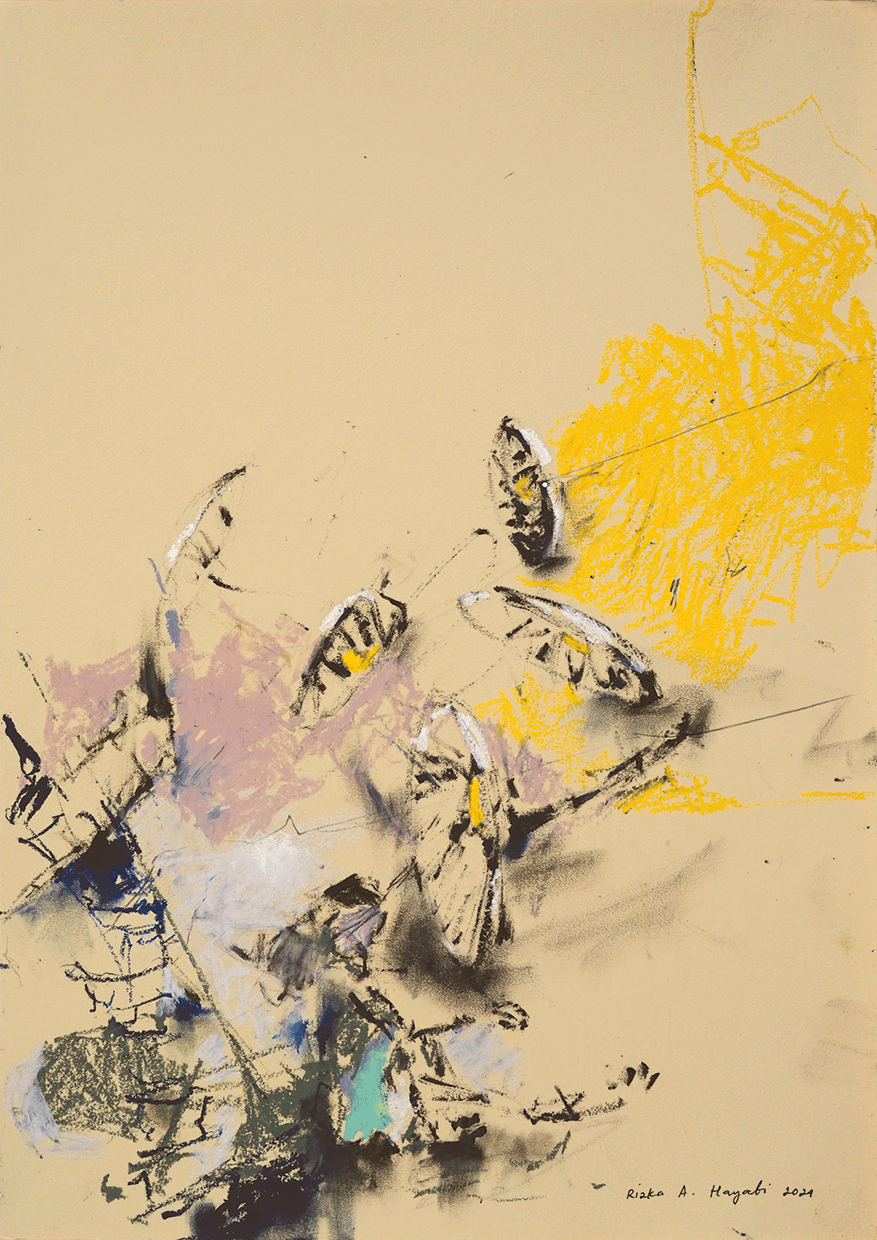
Rizka Azizah Hayati
Aku dan Roda-Roda, 2024
Oil pastel on paper
42 x 29.7 cm

Rizka Azizah Hayati
Tiang-Tiang Menubuh, 2024
Oil pastel on paper
42 x 29.7 cm

Rizka Azizah Hayati
Lekat Rusuk, 2024
Oil pastel on paper
42 x 29.7 cm

Rizka Azizah Hayati
Rintik Patah, 2024
Oil pastel on paper
42 x 29.7 cm

Rizka Azizah Hayati
Berkemas, 2024
Oil pastel on paper
42 x 29.7 cm

Rizka Azizah Hayati
Cahaya Dalam Gelap, 2024
Oil pastel on paper
42 x 29.7 cm

Rizka Azizah Hayati
Memancar Biru, 2024
Oil pastel on paper
42 x 29.7 cm

Rizka Azizah Hayati
Wildflower, 2024
Oil pastel on paper
42 x 29.7 cm
.png)
Rizka Azizah Hayati
Luruh (3), 2024
Oil pastel on paper
42 x 29.7 cm

Rizka Azizah Hayati
Setumpuk Aku, 2024
Oil pastel on paper
42 x 29.7 cm

Rizka Azizah Hayati
Mekar Dalam Tumpukan, 2024
Oil pastel on paper
42 x 29.7 cm

Rizka Azizah Hayati
Menonton Hujan Pecah, 2024
Oil pastel on paper
42 x 29.7 cm

Rizka Azizah Hayati
Jatuh untuk Mekar, 2024
Oil pastel on paper
42 x 29.7 cm

Rizka Azizah Hayati
Dharma, 2024
Oil pastel on paper
42 x 29.7 cm

Rizka Azizah Hayati
Wangi Pertemuan, 2024
Oil pastel on paper
42 x 29.7 cm

Rizka Azizah Hayati
Menonton Masa Lalu, 2024
Oil pastel on paper
42 x 29.7 cm

Rizka Azizah Hayati
Tubuh Biru Ibu, 2024
Oil pastel on paper
42 x 29.7 cm

Rizka Azizah Hayati
The Duck Is Spinning, 2024
Oil pastel on paper
42 x 29.7 cm

Rizka Azizah Hayati
Father's Son, 2024
Oil pastel on paper
42 x 29.7 cm