
15.09.25 — 12.10.25
Masih Bernadi
A group exhibition by Abdi Setiawan, Agus Suwge, Ahmad Zakii Anwar, Anusapati, Arin Dwihartanto, Dadang Rukmana, Dolorosa Sinaga, Eddie Hara, Eko Nugroho, Entang Wiharso, Goenawan Mohamad, Handiwirman Saputra, I Dewa Ngakan Made Ardana, I GAK Murniasih, Jumaldi Alfi, Justian Jafin, Kokok P Sancoko, Mella Jaarsma, Rizka Azizah Hayati, Samsul Arifin, Takashi Kuribayashi, Taufik Ermas, Teguh Ostenrik, Ugo Untoro, Yusra Martunus
Download E-Catalogue
25 Years of Nadi Gallery: An Equal and Flexible Partner
“Imagine that there were no art galleries. How then would we learn about contemporary art? We would
have to visit studios. Our galleries allow seeing a great variety of art relatively quickly. In one
busy morning in Manhattan, you can cover galleries in the Upper East Side; in a long afternoon, you
can walk through Chelsea. If a show isn’t promising, it’s easy to move on. Studio visits require an
appointment, and even if you’re disappointed, it’s rude to stay only briefly. Of course, you can
wait until art arrives at the museums, but then usually its appeal has been tested. What often is
most challenging for the critic is seeing art whose value has not yet been established—and that
happens frequently in the galleries. By being an intermediary between artist and collectors, the
dealer plays an essential practical role.” — David Carrier and Darren Jones, The Contemporary Art
Gallery: Display, Power, and Privilege (2016: 5)
“Indeed, good gallerists are knowledgeable art lovers, often investing all their money and more in
the futures of artists they believe in.” —Kyung An dan Jessica Cerasi, Who’s Afraid of Contemporary
Art (2017: 73)
Twenty-five years ago, inside the office of an architecture firm, Nadi Gallery came into being. Its
debut was marked by the presentation of Heri Dono’s solo exhibition, Humor and Rumor in Republic of
Cartoon (September 15 – October 1, 2000), which was a remarkable commercial success.
“I even had to hold a lottery to determine who could acquire Heri Dono’s work in that exhibition”,
recalled Biantoro Santoso, founder and owner of Nadi Gallery. “Sensational! Collectors had to pick a
lot to purchase artworks from a newly born gallery!”
Only twelve days after Heri Dono’s exhibition, Nadi Gallery presented its second show, Fantasy of
Body (October 13 – October 29, 2000), a solo exhibition by I Gusti Ayu Kadek Murniasih. Once again,
this exhibition proved commercially successful. Which was an astonishing feat, since at the time,
Murniasih was still a nobody in Indonesian art world. Yet, Nadi Gallery amazingly sold dozens of her
artworks during the show. “Perhaps it’s because her artworks were still relatively affordable at the
time,” Biantoro Santoso stated.
A couple of weeks later, Nadi Gallery opened Erica Hestu Wahyuni’s solo exhibition, My Dream and
Diary (November 17 – December 3, 2000). Following its predecessor, this too achieved extraordinary
commercial success.
“Everything is sold out, none remained,” claimed Biantoro Santoso.
The main driving forces behind the success of these exhibitions, all curated and written by Hendro
Wiyanto, were the combination of keen observation sense in reading the dynamics of supply and demand
for prominent artists’ works sought after by collectors or Indonesian art market and the courage to
bring forth new, distinctive and fresh works by little-known local artists.
That combination, supported by thoughtful curation, incisive writing and carefully designed
presentation, established Nadi Gallery’s benchmark for exhibitions, whether solo, group, or in local
and international art fairs. That standards remain intact to this day. Consequently, with all the
high-quality exhibitions and artworks, Nadi Gallery splendidly build and cement its reputation over
the past twenty-five years.
Building on that, to borrow the words of Hannah Wohl in Bound by Creativity: How Contemporary Art is
Created and Judged (2021: 31), there are three creative consensus that will be carefully negotiated
in Nadi Gallery’s interaction with artists and curators: what kinds of work artists make, how to
arrange these works in the exhibition space, and the exhibition timeline.
“Yet, I always try to remain flexible,” emphasized Biantoro Santoso. “I always prioritize an equal,
friendship-based approach.”
Evidently, as how Biantoro Santoso stated, he successfully convinced respectable and reputable
artist, such as Heri Dono, to conduct his solo exhibition, either at Nadi Gallery or other venue
that is organized by Nadi Gallery, multiple times. In Nadi Gallery’s archive, there are four records
of Heri Dono’s solo exhibitions, in 2000 and 2002 (both at Nadi Gallery), 2004 (at the National
Gallery of Indonesia) and 2008 (at Nadi Gallery).
The same ethos proved to be more impactful on Agus Suwage. Referring to same archive, Agus Suwage
has had nine solo exhibitions with Nadi Gallery, scattered across several venue — at Nadi Gallery
(2001, 2002, 2007, 2012, 2014, 2015), The National Gallery of Indonesia (2003), ARTSingapore (2004)
and CIGE, Beijing, China (2008).
Following their footsteps, Handiwirman Saputra also developed a strong relationship with the
gallery. According to the archives, he had six solo exhibitions with Nadi Gallery: at the gallery
itself (2004 and 2007), and other international venues organized by the gallery such as CIGE,
Beijing, China (2008), Singapore Show Case (2008), The National Gallery of Indonesia (2011),
TOLOT/heuristic Shinonome, Tokyo, Japan (2015).
Other artists who have had multiple solo exhibition with the gallery include Ugo Untoro (2002, 2009,
2025), Eddie Hara (2007, 2011, 2017), Abdi Setiawan (2007, 2022), Jumaldi Alfi (2008, 2011), Laksmi
Shitaresmi (2010 at Nadi Gallery; 2012 at The National Gallery of Indonesia) and S. Teddy D. (2007,
2015).
From the artists’ perspective, such repeated collaborations have been made possible by Nadi
Gallery’s ability to support their creative vision. To quote Hannah Wohl (2021: 9), “Creative
visions represent a bundle of meaningful consistencies within a body of work, which changes over
time as the body of work evolves.”
I Dewa Ngakan Made Ardana acknowledged and testified that it was that ability that made his solo
exhibition, In the Face of the Shadow (February 25 – March 15, 2020), possible.
“Nadi Gallery did not invite me, but rather it was me who proposed my solo exhibition to Mr.
Biantoro, because I have faith on him to understand and embrace my creative vision through my
exhibited works,” Ardana told me by phone last August in our two-hours conversation.
Similarly, it was the same spirit of recognition and openness that shaped earlier collaboration.,
such as Jendela Group’s group exhibition, The Ordinary (July 20 – August 1, 2005), Sanggar Sakato’s
Re-Reading Landschap (September 6 – 29, 2005), Iwan Effendi and others’ Freedom in Geekdom (January
20 – February 9, 2009), Angki Purbandono and others’ contemporary photography exhibition, Look! See?
(February 9 – 23, 2010), Made Wiguna Valasara and others’ Unload/Reload (March 14 – 26, 2012),
Sanggar Sakato’s Menolak Sekaligus Merengkuh (August 8 – 28, 2017) and NU-Abstract’s group
exhibition, NU-Abstract: Political Aesthetic (July 5 – 22, 2018).
With Biantoro Santoso’s openness to artists’ evolving creative visions along these past twenty-five
years, it is undeniable that Nadi Gallery has built and nurtured its relationship with all its
artists, not merely based on economic interests but also mutual respects.
While economic interests, such as promotion, distribution and money, are indeed valuable, as Kyung
An and Jessica Cerasi remind us (2017: 73), “often the most important support comes in the form of
helpful feedback and advice.”
In other words, align with Henrik Hagtvedt’s point of view in Money and Marketing in the Art World
(2025: 48), galleries and artists “can also establish close social bonds and function more like a
friend and mentor than a business partner or employer.”
Perhaps this is the secret that enables Nadi Gallery to thrive these past twenty-five years, a
significant, mature or even can be considered advanced age in Indonesia’s art scene today.
That secret underpins Nadi Gallery’s distinctive role and contribution, sustaining it to this day
and making it MASIH BERNADI (still pulsing). Marking its name as a pivotal subject in Indonesia’s
art scene during this past two and a half decades. Recording 152 art exhibitions (68 solo
exhibitions and 84 group exhibitions) with 235 artists from across generations, both Indonesian and
international.
Thus, let’s regard this exhibition, MASIH BERNADI, as a humble celebration for celebrating the 25th
anniversary of an art gallery. With that in mind, let us all witness and honestly evaluate all the
artworks by all the participating artists in this exhibition.
What the audience may encounter in this modest celebration is something rare and resonant, works
imbued with depth, significance, and affection, that together pay tribute to the enduring stature
and dignity of Nadi Gallery.
In accordance to the dignity, I recall the words of Matthew Israel in his book, A Year in the Art
World: An Insider’s View (2020: 3):
“Art history is not just the story of artists and movements, but of all the people and institutions
that collaborate with and support those artists and their work (...) It was fascinating to realize
just how much a great gallery can influence an artist's career.”
In this 25th anniversary, I want you to believe that Nadi Gallery is a part of that story.
Jakarta, September 15, 2025
WAHYUDIN

Abdi Setiawan
Jagoan, 2025
Teakwood, acrylic, spray paint, resin, color pigment
84 x 26 x 37 cm

Agus Suwge
Melaju ke Timur, 2025
Oil and acrylic on linen
150 x 200 cm

Ahmad Zakii Anwar
Taboo#01, 2023
Ink on 300 gsm archival paper
29,7 x 21 cm

Ahmad Zakii Anwar
Taboo#02, 2023
Ink on 300 gsm archival paper
29,7 x 21 cm

Ahmad Zakii Anwar
Taboo#03, 2023
Ink on 300 gsm archival paper
29,7 x 21 cm

Ahmad Zakii Anwar
Taboo#04, 2023
Ink on 300 gsm archival paper
29,7 x 21 cm
Ahmad Zakii Anwar
Taboo#04, 2023
Ink on 300 gsm archival paper
29,7 x 21 cm

Ahmad Zakii Anwar
Taboo#06, 2023
Ink on 300 gsm archival paper
29,7 x 21 cm

Ahmad Zakii Anwar
Taboo#07, 2023
Ink on 300 gsm archival paper
29,7 x 21 cm

Ahmad Zakii Anwar
Taboo#08, 2023
Ink on 300 gsm archival paper
29,7 x 21 cm

Ahmad Zakii Anwar
Taboo#09, 2023
Ink on 300 gsm archival paper
29,7 x 21 cm

Ahmad Zakii Anwar
Taboo#10, 2023
Ink on 300 gsm archival paper
29,7 x 21 cm

Ahmad Zakii Anwar
Taboo#11, 2023
Ink on 300 gsm archival paper
29,7 x 21 cm

Ahmad Zakii Anwar
Taboo#12, 2023
Ink on 300 gsm archival paper
29,7 x 21 cm

Anusapati
Totem Series #1, 2024
Saman tree wood
80 x 20 x 20 cm

Arin Dwihartanto
Caligo Carbonis, 2025
Coal, pigmented resin and canvas mounted on wooden panel
142 x 179 x 5,5 cm

Dadang Rukmana
Hutan Biru, 2025
Acrylic on canvas
160 x 180 cm

Dolorosa Sinaga
Creativity Is a Joy Forever, 2025
Aluminum foil, resin, silver coating mix with gold color
137 x 43 x 8 cm & 136 x 37 x 8 cm
, 2018 - 2025, Acrylic on canvas, 140 x 100 cm.webp)
Eddie Hara
Drawing No. 4057 (HIP HIP HOORAY), 2018
Acrylic on canvas
140 x 100 cm

Eko Nugroho
New Life New Personality, 2022
Acrylic on canvas
250 x 200 cm

Entang Wiharso
Lotus Flower with Double Portrait, 2023
Aluminum, car paint, gold leaf and polyurethane
103 x 103 cm

Goenawan Mohamad
Persistensi Palestina, 2025
Mixed media on canvas
100 x 148 cm
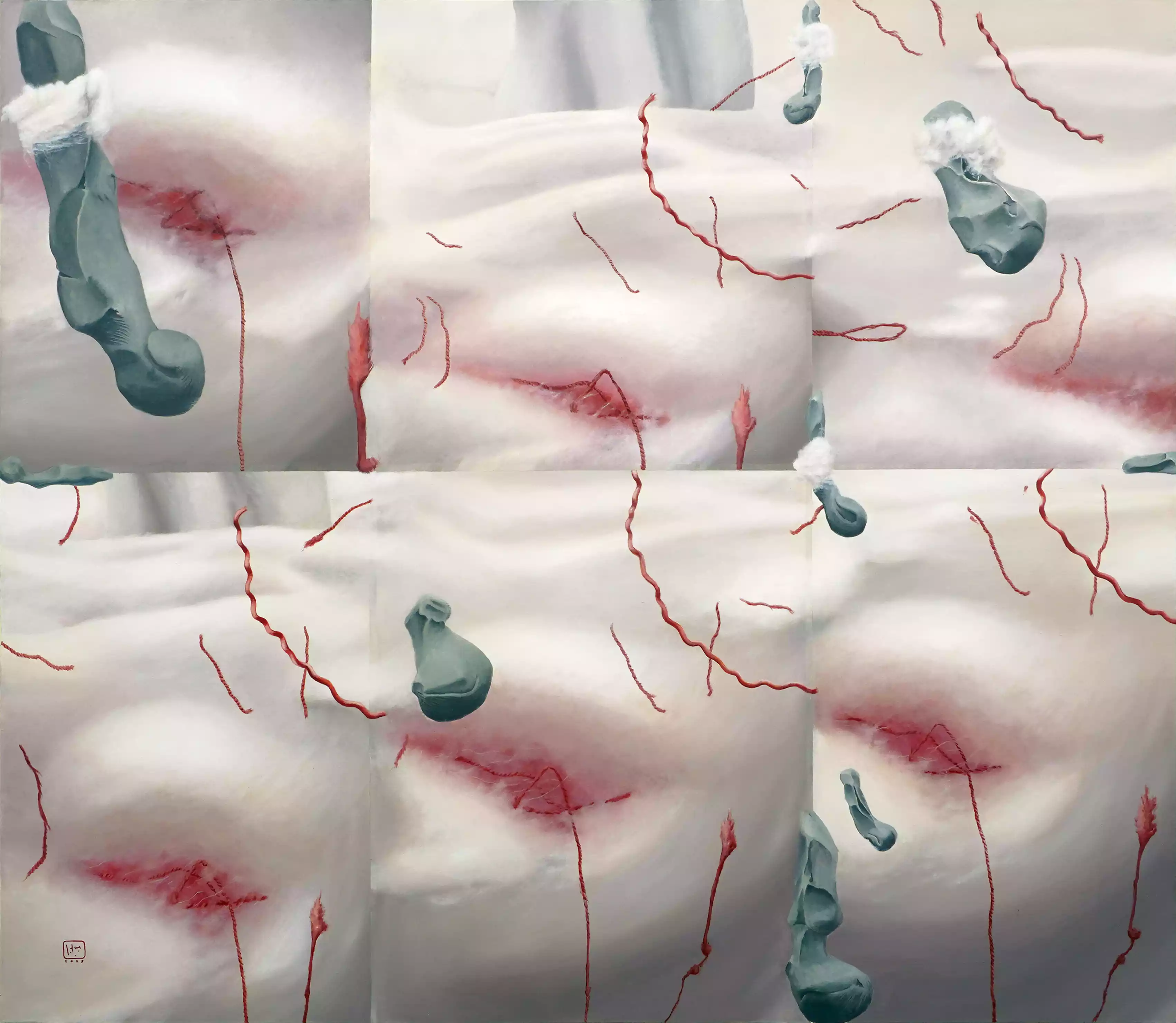
Handiwirman Saputra
Sekepal Berpilin Bertaut, 2025
Acrylic on canvas
204 x 234 cm

I Dewa Ngakan Made Ardana
Study of S. Sudjojono, 2025
Oil on canvas
54 x 63,5 cm

I Dewa Ngakan Made Ardana
Study of S. Sudjojono, 2025
Oil on canvas
54 x 63,5 cm
, 2001, Acrylic on canvas, 20 x 25 cm-MHM.webp)
I GAK Murniasih
Fasion 12 (Fashion 12), 2001
Acrylic on canvas
20 x 25 cm

Jumaldi Alfi
Ars est ludus mentis #1, 2025
Acrylic on canvas
120 x 60 cm

Jumaldi Alfi
Ars est ludus mentis #2, 2025
Acrylic on canvas
120 x 60 cm

Justian Jafin
Interaksi dan Eksistensi, 2025
Acrylic on canvas
150 x 150 cm

Kokok P Sancoko
'siku', Melankolik Matra, 2025
Oil, acrylic, charcoal and pencil on canvas
120 x 80 cm

Mella Jaarsma
Kakies on a Broken Slope I, 2025
Acrylic, charcoal, woodblock print on canvas
250 x 55 cm
, 2025, Iron rust dye, elastomeric waterproof, transparent gesso and acrylic on canvas, 100 x 120 cm-MHM.webp)
Rizka Azizah Hayati
Connected (1956), 2025
Iron rust dye, elastomeric waterproof, transparent gesso and acrylic on canvas
100 x 120 cm

Samsul Arifin
Pilgrim, 2025
Acrylic on canvas
200 x 200 cm

Takashi Kuribayashi
Road to Documenta Fifteen #02, 2025
Mixed media on washi paper
100 x 149,5 cm
, 224 x 145 x 29 cm-MHM.webp)
Taufik Ermas
Bentang Lengkung, Bertekuk Lipat #2, 2025
Acrylic on modified canvas (iron plate, EVA sponge, plywood, wood veenir)
224 x 145 x 29 cm

Teguh Ostenrik
Ascent into the Light, 2025
Fiber casted
77 x 22 x 28 cm
, 2021, Oil on canvas, 200 x 150 cm-MHM.webp)
Ugo Untoro
Dia Menunggu (Panel 2-3 of Dia Datang, Dia Menunggu, Dia Pergi After Affandi), 2021
Oil on canvas
200 x 150 cm
, 2023, Acrylic on canvas, 150 x 150 cm-MHM.webp)
Yusra Martunus
23206 (Dynamic), 2023
Acrylic on canvas
150 x 150 cm
, 2023, Acrylic on canvas, 190 x 85 cm-MHM.webp)
Yusra Martunus
23207 (Balance), 2023
Acrylic on canvas
190 x 85 cm