
Solo exhibition by Samsul Arifin
The Quest
The obsession of painters with a single visual object is a
recurring theme in modern art history. Monet’s more than
250 water lily paintings slightly surpass O'Keeffe's 200-plus
flower paintings. Frida’s repeated self-portraits are no different
from Affandi, who spent his entire life exploring his own face
and figure. We see Kusama still immersed in polka dots.
Basuki often painted female figures with the same intensity
as Srihadi, who never tired of painting dancers on the horizon
and Borobudur. Popo was known for his love of cats, similar to
Ugo, who spent years focused solely on horses.
There is no absolute answer to why this obsessive tendency
continues to pervade many painters today. Every artist surely
has their own reasons. However, it is understandable to
assume that this tendency reflects the artist’s ‘obedience’
to the production and reception patterns in the art world—
where works that receive a positive response are likely to be
repeated. Labeling also plays a significant role: once an artist
is known for a particular object or visual idiom—whether it
be self-portraits or floral motifs—such labeling or praise from
art critics and enthusiasts tends to encourage continued
exploration. This labeling strengthens the artist’s focus or
obsession. This process creates a feedback loop, where an
artistic tendency that may have initially been spontaneous
or experimental eventually becomes a foundation for the
artist’s ‘obsession’ or ‘artistic identity.’ In a competitive art
world, a consistent and unique artistic identity becomes a
distinguishing factor for an artist.
The discussion of artistic obsession opens the way to delve
into the works of Samsul Arifin. Since the early 2000s, Samsul
has remained faithful to paintings, sculptures, and installations
centered around objects such as fabric dolls, pencils, and
erasers. In his third solo exhibition, The Quest, dolls and pencils
once again dominate. However, to merely call it a repetition may
be an oversimplification. This exhibition shows that Samsul digs
deeper and leaps forward by introducing new visual objects.
Few curators have analyzed the background and motives
behind Samsul's attachment to objects like dolls, pencils,
and erasers, especially from a biographical perspective. As
noted respectively by Supangkat and Wardani, the fabric dolls
cannot be separated from Samsul's childhood as the son of
a seamstress. Samsul was born and raised in a village called
Dampit, Malang, East Java, where he helped his grandmother,
father, and sister measure, cut, and sew fabric with thread
and needle. Meanwhile, the pencil and eraser symbolize his
struggle to complete his education and earn a degree to fulfill
his father's wishes, as his father worked as an elementary
school teacher.
Undoubtedly, these biographical facts remain relevant in
interpreting Samsul Arifin's works in his solo exhibition The
Quest. Three paintings—Ode untuk Ibu, Ode untuk Sang Guru
and Enam Sedarah Sepenanggungan (Ode for Mother, Ode
for the Teacher, and Six in Solidarity)—still reflect personal
life experiences that shape his artistic perspective. In the first
painting, the figure of a mother is depicted through sketches
resembling women carrying heads (his mother being the
family breadwinner after his father’s death). Meanwhile, in the
second painting, a male figure appears holding books. In both
of these paintings, dolls lie horizontally across the canvas,
with body parts separated and wrapped in measuring tape—a
metaphor for helplessness.
In the final painting, Samsul illustrates six human figures
resembling silhouettes made from worn-out paper,
symbolizing the arduous struggle of him and his five siblings
to pursue their education. Samsul, the fifth of six children,
was the one who had to travel the farthest (to Yogyakarta)
for school from a young age (note the figure of the traveler in
the bottom right corner of the canvas). While in Yogyakarta,
Samsul's life was heavily supported by his older siblings who
had already started working.
I won’t dwell too much on Samsul’s tough and bitter life
story. What matters more is understanding how a biography
remains relevant in interpreting an artist's ‘obsession.’ The
life of a painter can help us understand their artistic actions.
If we agree that daily human actions are inevitably influenced
by experiences, memories, and traumas that seep into the
subconscious, it becomes easier to comprehend why an artist
repeatedly returns to certain objects. In Samsul’s case, the
doll, pencil, or eraser is more than just an artistic identity.
Samsul's past stories can lead us to a deeper understanding
of his artistic temperament. This doesn’t mean we should
always reduce the meaning of a work of art solely to the
artist's life facts. However, in the artistic obsessions that recur,
there are undeniable traces of personal history. A child from
a family of tailors, for instance, might see the world through
pieces of fabric, needles, and thread, which he would weave
into toy dolls during his free time. The child of a teacher might
see life as a lesson that needs to be erased and rewritten
continuously. In Sang Pemikir (The Thinker), a doll made of
leather is shown sleeping on a book, with walls and ceilings
full of wild scribbles, letters, or scientific formulas.
For every doll in his paintings, Samsul always makes the
‘models’ by hand. Usually, they are mini-sized and adorned
with accessories like masks, scarves, pencils, or backpacks.
Some ride horses or camels. This doesn't mean he can't paint
the dolls directly without the models. For Samsul, making dolls
by hand is part of his personal expression. He photographs
the dolls to create a kind of scenography for his paintings. For
some past exhibitions, he has also enlarged the dolls into lifesized
sculptures.
We cannot overlook the uniqueness of Samsul's dolls. In
contrast to polished factory-made dolls, Samsul's creations—
whether in paintings, sculptures, or installations—exude a
radical simplicity that feels almost primitive. He often chooses
burlap, a material that asserts its raw, unrefined quality. The
bodies of Samsul's dolls are never proportionate or detailed;
he seems to express something simple and fundamental: a
truth in imperfection. These dolls are without gender yet draw
attention with a striking feature: their round eyes, large pupils
brimming with curiosity, as if perpetually questioning the world
around them. Unlike Murakami, who names his characters,
Samsul does not bestow special names upon his dolls. Even
when a curator dubbed one of them 'Goni' in 2008, Samsul
has not readily adopted this name in all instances. For him,
anonymity grants greater freedom and flexibility for his dolls to
become part of the audience's imagination.
One of the hallmarks of Samsul's paintings lies in his
presentation of the tension between two expressive languages
in art: the meticulous, detailed, and refined on one side,
and the wild, unrestrained, and formless on the other. His
burlap dolls, whether made of fabric or skin, often feature
meticulous craftsmanship—each fold, wrinkle, and even
tear that reveals the stuffing feels palpable. However, the
backdrop of wild brushstrokes creates a striking contrast:
a dissonance between the intact figure and the seemingly
chaotic arrangement.
Membaca Batas Nurani (Reading the Boundaries of
Conscience) presents a black canvas with expressive white
strokes. Three doll figures are seen reading books while
perched on a pencil sharpened at both ends, one white and
the other black. For Samsul, black and white represent the
eternal opposition between evil and good. Here, the visual
tension between the orderly and the wild intertwines with the
concept of dualism: "No matter how high one studies or seeks
knowledge, it remains futile if one cannot discern good from
evil," he states.
Samsul’s fabric dolls, depicted realistically, may evoke empathy
and admiration for his artistic skill. Meanwhile, the tumultuous
scribbles, defying the rules of form or line, reflect inner chaos
or an uncontrollable world. When juxtaposed together, these
two elements present a tension between stability and unrest.
The dolls become entangled in a larger visual struggle—a
world filled with harsh strokes, perhaps a symbol of mental
turmoil, confusion, or even an inability to find wholeness.
In Samsul's work, the meeting of order and chaos portrays
an effort to preserve something fragile amid an uncertain
environment. The expressive strokes may symbolize
an unending search for meaning, where the dolls—as
symbolic objects of the past—struggle to endure within the
unpredictable currents of life. Such narratives are evident in
Keresahan si Petualang (The Restlessness of the Adventurer),
where we find the artist's self-representation in a doll holding
a brush. In Gugur (Fallen), we sense the tenuous connection
between the doll figure and a dismembered body amidst a
backdrop of wild lines depicting war. A ruined book lies on the
ground, symbolizing the collapse of knowledge or truth.
In the exhibition title "The Quest," there lies more than just
an ongoing artistic exploration by Samsul. The journey is
one that never truly arrives at a destination. Within it, stories
are wrapped in every pose and arrangement of the objects
that fuel the artist’s obsession. Indeed, these stories can be
very personal: the dolls that Samsul paints often reflect his
life history. Yet, if we dare to immerse ourselves in a broader
imagination, these dolls and pencils also speak not only of
their creator's tales but about you and all of us, the human
inhabitants of this planet.
Humans, as Harari notes, are not mere creatures of instinct;
they are wanderers and seekers of meaning, builders of
stories. Samsul's dolls reflect the human journey: from those
who first carved stone tools to those who now construct
theories to understand the universe. Humans survive not
by their physical strength but by their ability to create myths
and forge cooperation. In several sculptures that Samsul
has developed from pencil objects (see: Catatan Hitam and
Gelapnya Sejarah, translated respectively: 'Dark Notes' and
'The Shadows of History'), humanity creates history and
knowledge as a 'myth' it cannot control, ultimately benefiting
only a select few. Science and technology allow humans to
conquer nature, combat diseases, and extend life. Both are
extraordinary powers that have transcended the physical
limits of humanity and ushered us into a new era where we no
longer submit to the laws of nature but control them.
The irony accompanying this progress is that science is
always a double-edged sword. It is not merely a tool for
uncovering truth but part of the machinery of power—
aligned with capitalism, imperialism, or specific ideologies.
The scientific knowledge we acquire, rather than guiding
us to enlightenment, is often directed towards exploitation,
domination, and the accumulation of capital for maximum
profit. In works like Gemah Ripah Loh Jinawi and Generasi
Emas (Golden Generation), this critique is palpable. Through
his plain fabric dolls, Samsul captures the absurdity of the
promises of welfare offered by capitalist forces. Mendayung
Mendulang (Paddling and Harvesting) for instance, depicts a
simple doll rowing a boat filled with gold bars—a striking irony
between innocence and greed. The boat seems to navigate
a sea of illusions, a journey that appears to lead to prosperity,
yet harbors uncertainty and ambiguity beneath the surface.
Science, in its modern guise, is not merely a neutral quest for
truth. It has become an instrument of domination, a means
for humanity to conquer the earth and all it contains. In the
installation Anatomy dari Kata-kata (Anatomy of Words),
Samsul illustrates this narrative through a shark's torn body
washed up on the shore, seemingly symbolizing nature
subdued before humanity. Yet most shocking is how the
interior of the shark's body reveals not its natural organs but
thousands of letters, suggesting that there are no longer
mysteries unread or unsolved by humanity in this age.
Knowledge, ultimately, has transformed the world into a text
that can be fully dissected and owned.
It is not entirely misguided to associate "The Quest" with a
religious journey. In conversations with me, Samsul once
shared his dream of performing the Hajj. That desire was
fulfilled last year, and from that spiritual experience, his
works featuring dolls as travelers, like in "Endless Journey,"
gained a new layer of meaning. For Samsul, the human
journey is inextricably linked to the pursuit of knowledge.
Yet, in Samsul's view, still firmly holding his father's legacy,
knowledge is not merely an end goal—it is both a guide and
a refuge. In paintings like Sebaik-baiknya Bekal adalah Ilmu
(The Best Provision is Knowledge) and Yang Menjaga Tempat
Berlindung (The Guardian of a Shelter), Samsul depicts books
as a metaphor representing knowledge. But as he further
states, human knowledge should retain a spiritual and social
dimension that must be preserved from extinction (see the
books in the painting Penyelamat, translated: The Rescuer).
In Samsul Arifin's artistic journey, his 'obsession' with certain
visual objects is not mere mechanical repetition. There is
depth born from this persistence, driving him to explore
questions that remain unresolved. Like a child endlessly
playing with the same toy, Samsul, with his dolls and pencils,
is reconstructing his own world, layer by layer. Every artist
who engages with a single object, idiom, form, or style
throughout their life is, in essence, carving a path towards
a deeper understanding. Artistic obsession is a sign of total
commitment to an idea—one that reflects how modern
humans grapple with the complexities of the world.
Agung Hujatnikajennong
Bibliography
Samsul Arifin's solo exhibition catalogue, Goni's Journey, Galeri Semarang,
2008
Samsul Arifin's solo exhibition catalogue, The Maker, Ark Gallery, 2010
Yuval Noah Harari, Sapiens, Jakarta: Kepustakaan Populer Gramedia, 2017

Samsul Arifin
Anatomi Dari Kata-Kata, 2019
Resin
72 x 500 x 145 cm

Samsul Arifin
Berlindung Pada Ilmu, 2023
Acrylic on canvas
150 x 200 cm
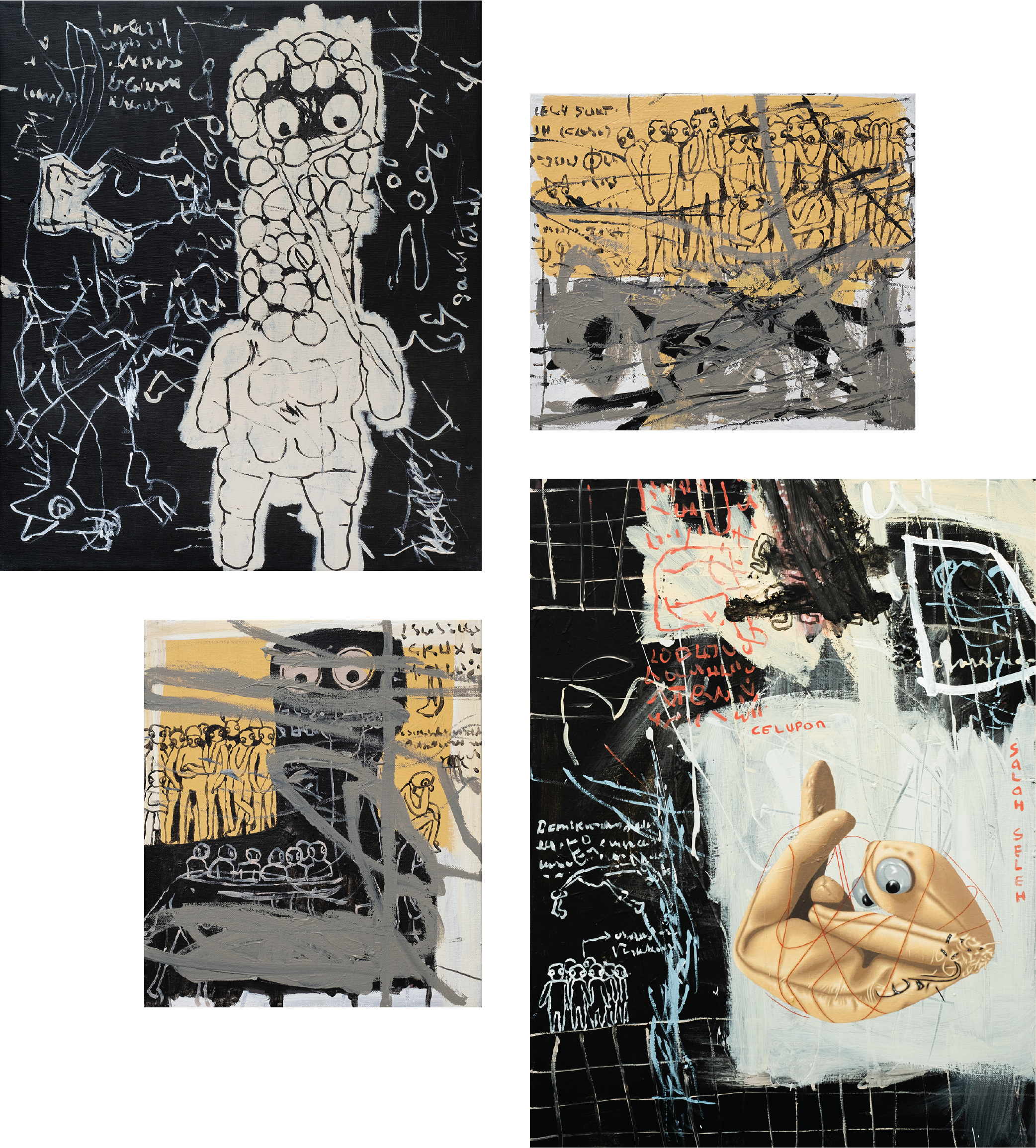
Samsul Arifin
Bungkam Dalam Derita, 2024
Acrylic on canvas
4 pcs (60 x 50, 35 x 40, 40 x 35, 70 x 52,5 cm)

Samsul Arifin
Catatan Kelam, 2020
Resin
24 x 230 x 30
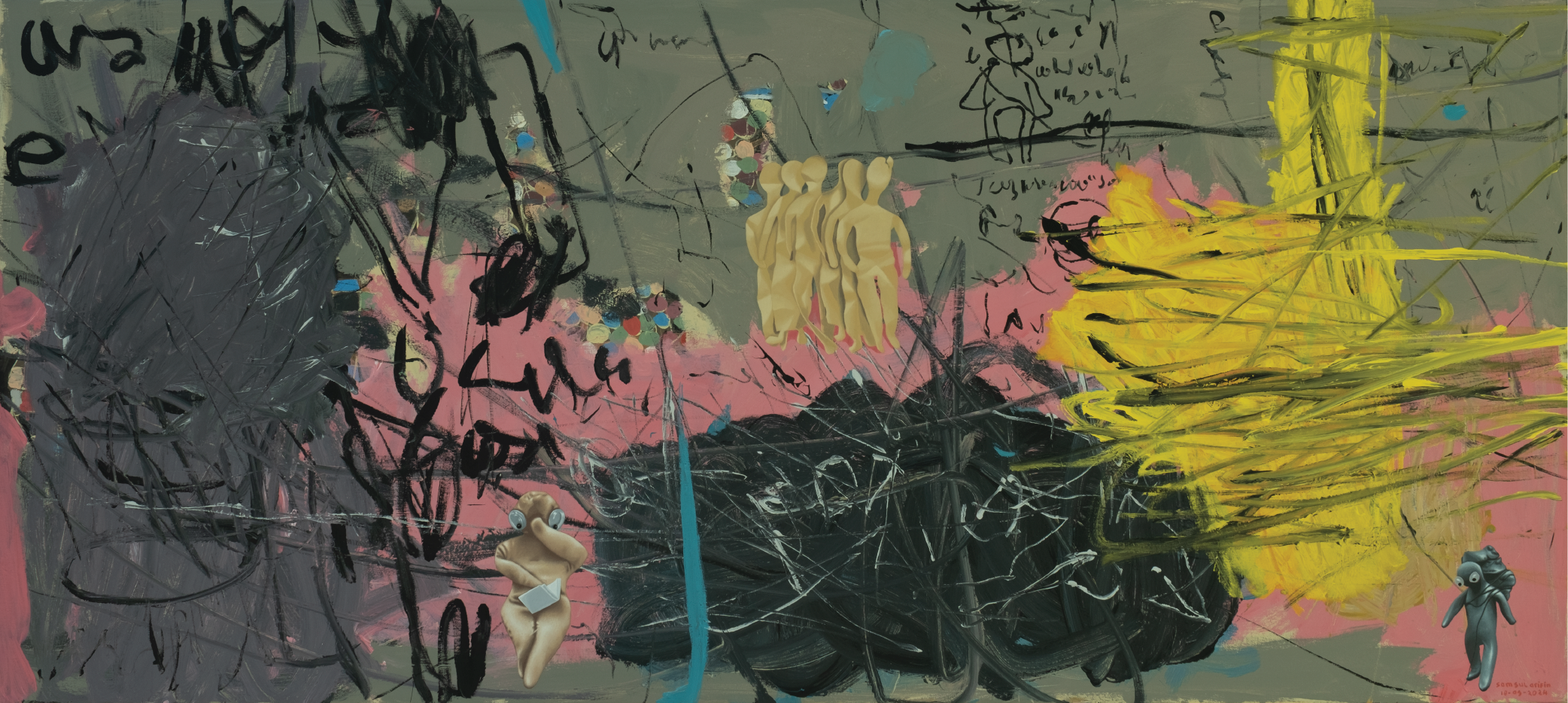
Samsul Arifin
Enam Sedarah Sepenanggungan, 2024
Acrylic on canvas
90 x 200

Samsul Arifin
Gelapnya Sejarah, 2020
Resin
26 x 168 x 28
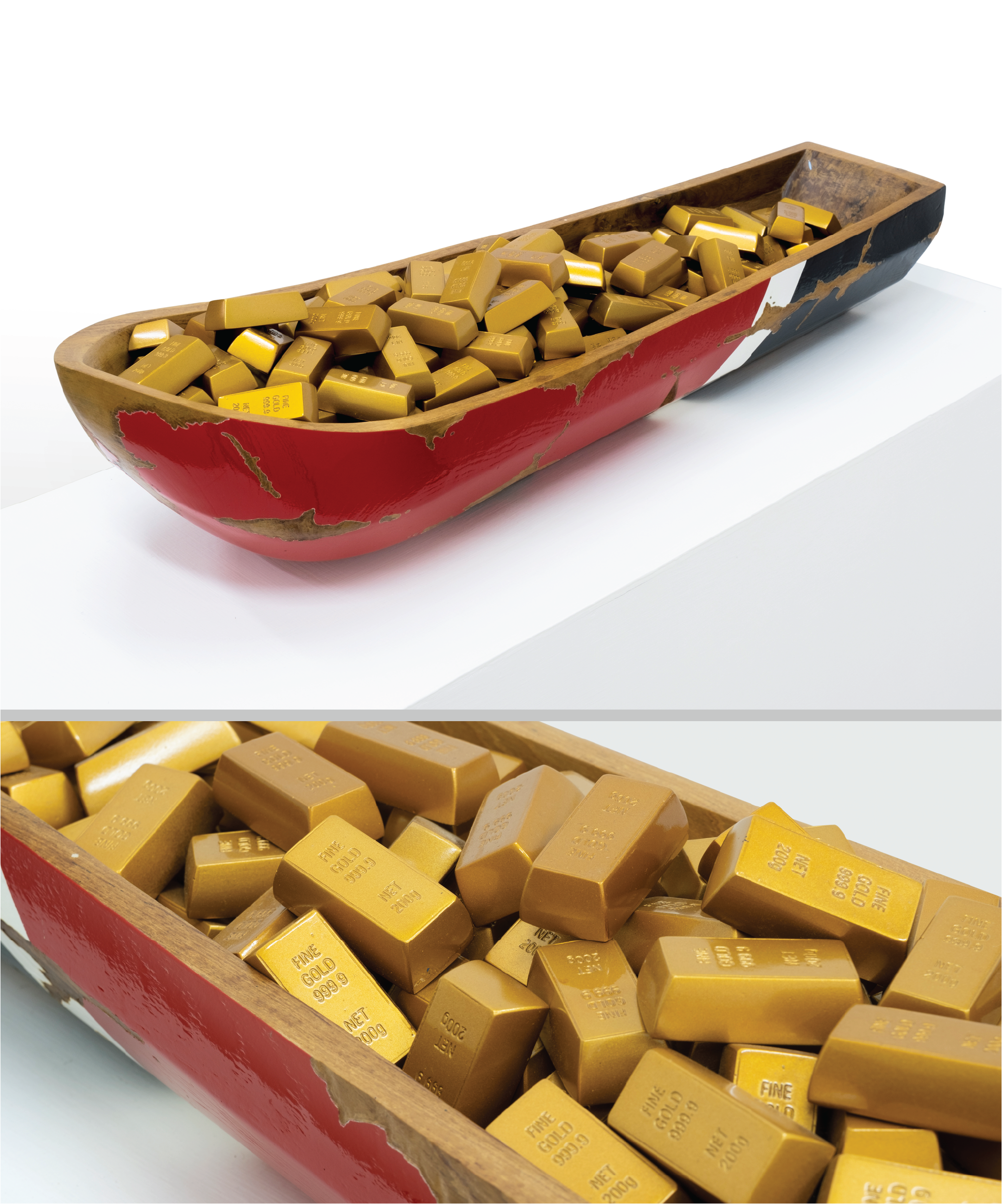
Samsul Arifin
Gemah Ripah Loh Jinawi, 2023
Wood, resin
17 x 69 x 20 cm
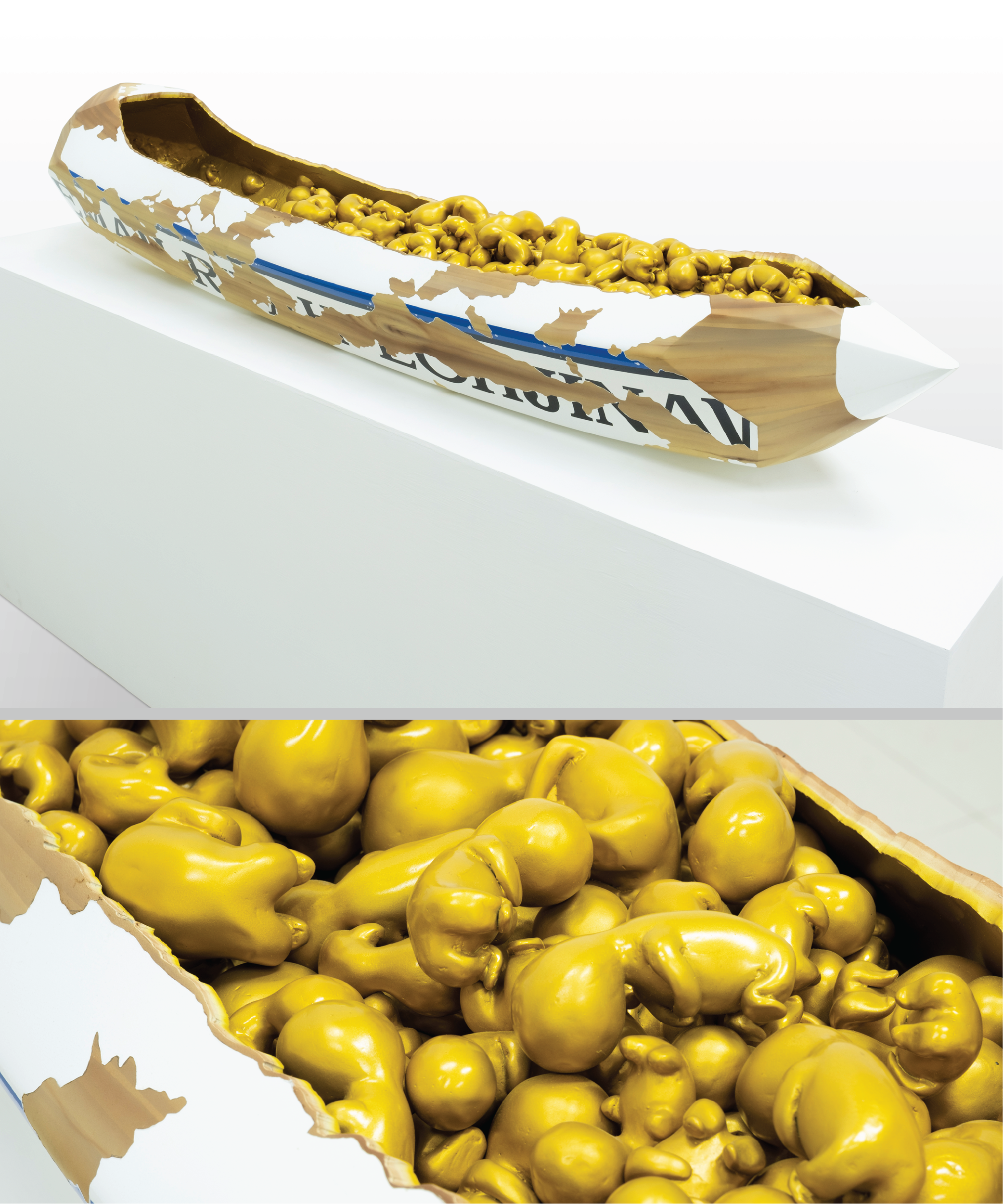
Samsul Arifin
Generasi Emas, 2021
Resin
30 x 163 x 32 cm

Samsul Arifin
Gugur, 2023
Acrylic on canvas
100 x 300 cm

Samsul Arifin
Gumun, 2024
Acrylic on canvas
5 pcs (40 x 30, 50 x 50, 30 x 20, 40 x 30, 40 x 35 cm)

Samsul Arifin
Jerembab, 2024
Acrylic on canvas
60 x 50 cm

Samsul Arifin
Keresahan Petualang, 2024
Acrylic on canvas
200 x 170 cm

Samsul Arifin
Mempelajari Batas Nurani, 2024
Acrylic on canvas
200 x 300 cm

Samsul Arifin
Mendayung Mendulang, 2023
Wood
22 x 44 x 40 cm
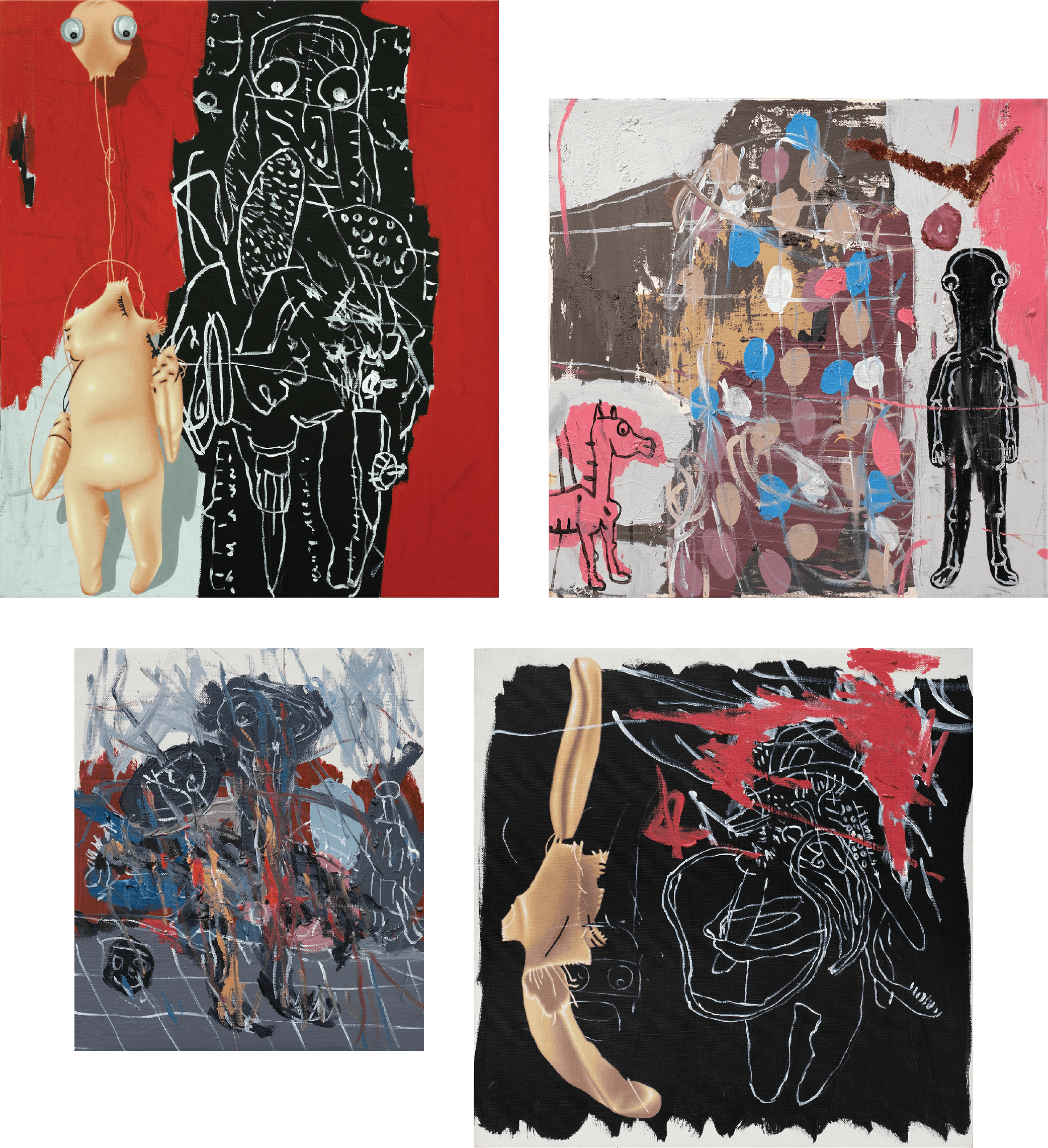
Samsul Arifin
Obsesi, 2024
Acrylic on canvas
4 pcs (60 x 50, 45 x 35, 50 x 50, 50 x50 cm)

Samsul Arifin
Ode Untuk Ibu, 2024
Acrylic on canvas
100 x 150 cm

Samsul Arifin
Ode Untuk Sang Guru, 2024
Acrylic on canvas
100 x 150 cm

Samsul Arifin
Pendulang, 2021
Resin
24 x 170 x 29 cm

Samsul Arifin
Penyelamat, 2024
Acrylic on canvas
200 x 300 cm

Samsul Arifin
Perjalanan Tak Berujung, 2024
Acrylic on canvas
150 x 100 cm

Samsul Arifin
Rindu Damai, 2024
Acrylic on canvas
5 pcs( 40 x 60, 35 x 40, 60 x 50, 60 x 50, 50 x 60 cm

Samsul Arifin
Sang Pemikir, 2023
Acrylic on canvas
100 x 150 cm

Samsul Arifin
Sebaik-baik Bekal Adalah Ilmu, 2023
Acrylic on canvas
150 x 300 cm

Samsul Arifin
Tabir, 2024
Acrylic on canvas
60 x 50 cm

Samsul Arifin
Yang Menjaga Tempat Berlindung, 2023
Acrylic on canvas
150 x 200 cm