
A Solo Exhibition by Abdi Setiawan
Abdi Setiawan Burns Slow
WAHYUDIN
“I don’t believe any artist would create just average artworks—unless they are shy or a liar.”
—Abdi Setiawan
“There is a myth that to create something new, to be creative in general, you have to reject anything traditional, forget the past, and begin anew.”
—Boris Groys
One of the visual art(ist) studios in Kersan hamlet, Tirtonirmolo, Bantul, which I often—if not most often—visited is Studio 221. I love visiting it because the owner is an artist who is open and likes to share stories, coffee, snacks, and even some air for my bicycle tires.
Studio 211 is the studio of the artist Abdi Setiawan—famously referred to as Set—located in an old house that is built in the 60’s. It is 150 m2 wide with two entrances, from the west is Jalan Assamawat, not far from Tunas Harapan PKK Kindergarten, and from the south is at the west side of a badminton court. The house consists of seven 2 x 4 rooms, and across it three toilets, a small kitchen, and a 72 m2 wide living room as the center of the studio wth various types of equipments, i.e. drill, sawing machine, electric air compressor, chisel, hammer, screwdriver and iron drum with copper brown lid 14 centimeters high and 57 centimeters in diameter that is used to burn wood cuts and woodchips.
Abdi Setiawan rented the house for the first time in 2004 from the family of the late Burjo Ponco Sadewo, the head of Tirtonirmolo village who was famous during the period of 1960’s to 1980’s. The house was once a shared work space with fellow artists Rudi Mantofani and Rudi Hendriatno, but in the last five years he used it alone as a work studio and residence for his family.
It was in Studio 211 that Abdi Setiawan created hundreds of sculpture works—except for the dozens of works for his first academic solo exhibition Gairah Malam (2004) that received high recognition from art lovers in Indonesia—, which established him as the Gepetto in the Indonesian contemporary art scene.
The last eighteen years have witnessed the births of various form and characters of “pinocchios” from his skillful hands. Some were pretty, some were hideous; some were funny, some were stiff; some were ostentatious, some were gentle; some were fierce, some were wise. But all of them attract invaluable imagination bombs. All of them are the imaginary children born from Abdi Setiawan’s humane struggles.
This allows the audience to have an adventure in the world of children’s imagination, to enter and discover the meaning of life or the life-reflections of adults as an individual and member of the community. This possibility was met in his solo exhibition, The Future is Here, at Redbase Contemporary Art, Jakarta, 30 October–30 November 2014.
In the exhibition, the Indonesian Art Institute (ISI) alumnus presented sculptures of children and adult figures that had been shown in various art exhibitions nationally and internationally in the last decade. To be exact, seven sculptures of boys that are “named” Aktor (2009), Batman (2011), Burger Time (2009), Commodore (2010), Kapiten (2009), The Tiger (2011), and Ultraman (2010). Excluding Batman and Tiger, which were made of fiberglass, the sculptures were made of wood.
Aktor, Batman, and Kapiten were once displayed in two European cities. The first one was in his solo exhibition, New Sculptures, at the Metis Gallery, Amsterdam, the Netherlands, 5 June–3 July 2010. The second one was in the New Sculptures solo exhibition at the Andre Simoens Gallery, Knokke, Belgium, 18 September–24 October 2010. Commodore, Ultraman, and The Tiger were displayed in The Victims for the 14th Jakarta Biennale, Maximum City: Survive or Escape? at the Indonesian National Gallery, Jakarta, for 30 days from 15 December 2011–15 January 2012.
Eleven months later, the three joined Aktor for one month display, 5 December 2012–5 January 2013, in a group exhibition titled A Sign of Absence at Edwin's Gallery, Jakarta. After a six months break, this time without Aktor, the sculptures went on display during RePLAY #4 event titled Malacca's Boys at the Office for Contemporary Art (OFCA) International, Yogyakarta, for 30 days from 28 June–28 July 2013. Whereas Burger Time together with Batman, was displayed along Andy Dewantoro’s and Eddie Hara’s contemporary painting artworks for one month, 8 March–7 April 2012, at Sin Sin Fine Art Gallery, Hongkong.
Aside of them, there is one sculpture of an adult figure, the Security Guard (2013), which previously was a polite and dedicated security worker for three months, 11 November 2013–10 January 2014, during the Yogyakarta Open Studio event at OFCA International, Yogyakarta.
With the impressive performance portfolio, Abdi Setiawan’s artistic practice could be considered as similar to the practice of directing in the art of performance, theatre, and film—which demands for skills and sensitivity in managing the performers, the story, and the stage. Not just empty talks, the sculptor who was born in Sicincin, Pariaman, West Sumatera on 29 December 1971 had created the visual works since 2004, when he exhibited sculptures of human figures from the suburban red district area in the Gairah Malam exhibition at the Indonesian-French Institute, Yogyakarta.
From then on, I have gained a “new” knowledge that not many people have, that the artistic practice of this Director of Sicincin Indonesia Contemporary Art Yogyakarta set off from what is considered as a “sexy” discourse in the Indonesian contemporary art world, which currently is known as research-based visual art practice or project—ethnographic research, to be precise. Therefore it is understandable if Abdi Setiawan dubbed his works as the art of narrative and reflective sculpture.
This means, on the sculptures of this Forum Ceblang Ceblung’s exponent is engraved what Susan Sontag described as image and text that offer two things simultaneously—the offer of sexual pleasure that is free from “content” and invitation to the utilization of intelligence. Thusfore, an opportunity is created to build a moment of democratic appreciation in each of his sculpture exhibition.
In that moment, Abdi Setiawan simply opened a tool box of aesthetic variety that enabled the audience to perceive the sculptures in accordance with their interests. By doing so, they became emancipated to exist between “common people” and “experts” in a semiotic activity that has the ambition to interpret meanings from signs and symbols in the artworks, or just spending leisure time in a visual art gallery.
In other words, every audience have the chance to celebrate the meeting with Abdi Setiawan’s sculpture work as an object of pleasure that enables them to immerse in a pool of intimacy filled with indescribable emotions and sensations. In the mean time they also have the chance for deep exploration and investigation of critical understanding on the sculpture work of the Sanggar Sakato’s member as the intellectual objects that wish to reflect time, actions, values, history, and human identity with an imaginary landscape of youth.
Whatever it is, the issue of any audience remains the same, how to be wise in a meeting that is yet-had passed with a visual artwork. The issue is about distance, both intellectual and emotional. As it turned out, in The Future is Here exhibition, Abdi Setiawan had already gently signaled this matter by presenting the sculpture of a small girl in the “embodiment” of soot and was “named” Girl a.k.a Kiss (2014).
Its presence not only implied the presence of observant viewers, but also, in the words of Jacques Ranciere, an image that refers to an-Other. It could mean that its presence is a new figure and principal that enables Abdi Setiawan to display new narratives on a new imaginary stage. Therefore, old figures are rejuvenated in the context of performance recreation, which enabled these figures together with Kiss to achieve a new unprecedented level of expression in the eyes of the audience.
Instead of depicting a marginalized weak figure, an object of misery that is neglected in the cruel patriarchal world, Kiss depicted the common main authority, with an overwrought facial expression and calm attitude, overseeing their flaccid apparatus of power and controlling the childish virility that is closely and carefully contrived.
As a result, Kiss’ existence allowed Abdi Setiawan to rejuvenate the old wisdom regading women and children as the master of the future and the source of glory of the audiences who keep contemplating on how visual art(ist) still keeps a precious treasure of life in the form of invaluable imagination bombs, able to detonate the masculine, wild, and violent world with meaningful human warmth.
***
Five years after The Future is Here exhibition, Kiss, Commodore, and Tiger (in wood), returned in the Set and His People exhibition in Galeri Semarang, 16 November–15 December 2019. So were Pinky, Tatto Man, Belaian Angin Malam, Salome, and Melepas Lelah, which once exhibited in The Flaneur at Nadi Gallery, Jakarta (2007); Asongan that was in A Sign of Absence at Edwin's Gallery, Jakarta (2013), The Chef alias Mooi Indie that was in Jogja Joged at Artjog, Yogyakarta (2014); Shooter that was in New Sculptures at the Metis Gallery, Amsterdam, the Netherlands (2010); Boogeyman that was in Melihat Indonesia at the Ciputra Artpreneur Centre, Jakarta (2013); Awas Anjing Galak that was exhibited at Gajah Gallery, Singapura (tt); and Si Pelukis Rakyat that was in Potret at the Bentara Budaya Yogyakarta (13–22 August 2019).
By doing so, Abdi Setiawan not only rejuvenated a number of his sculptures from the passing of times, but also redisplayed them for the renewal of artistic, economic, and discoursive values related to the new 12 sculptures he created in the course of ten months in 2019—i.e. To Be A Star, Kung Fu Boy, Jump, The Dreamer, Smoker, Akur, Mickey, Loro Blonyo Kiri, Loro Blonyo Kanan, Balance, The Spy, and Celebrities.
Aside of the dozen new sculptures, Set transferred the medium of the Malacca’s Boys’ protagonist sculptures—Aktor, Hero, and Sang Kapten—into portrait paintings in ridiculous pop art style. The same also happened with Boogeyman that incarnated into Bangsawan (Noble Man) in a piece of canvas on a background of Japanese and Western cartoon characters. The four paintings were created in 2019.
Up to that point, I must say that the newness of the 12 sculptures and 4 paintings was not due to the formal formal device and materials (since early 2000’s, Abdi Setiawan had utilized wood as the material for his sculpture works that he was able to articulate, if not break through, what sculptors Gregorius Sidharta [1932–2006] and Amrus Natalsya [1933] were using), it also didn’t lay in the sculpted, etched, or expressed contents (previously Abdi Setiawan had produced a number of similar sculptures and paintings in 2012 and 2017). The novelty laid on the context and the format of display.
(In his previous 6 solo exhibitions: Gairah Malam [2004], The Flaneur [2007], New Sculptures [in Belgium and Netherland, 2010], Re-Play #4 [2013], and The Future is Here [2014], Abdi Setiawan used a theatrical way of display, which, as I already mentioned above, already allowed him to become some sort of unique director in the tradition of contemporary sculpture art in Indonesia—which made him an artistic kinsman with the American sculptor-painter George Segal [1924–200]).
Well, in the Set and His People exhibition, Abdi Setiawan was no longer a director. Instead, he took a role akin to photographer who directed the sculptures to pose or acted in accordance with their given character, behavior, or inclinations. In this case, Abdi Setiawan reminds me on the artistic action of Stephan Balkenhol (1957), a Deutsch sculptor who now resides and works between Karlsruhe, Germany and Meisenthal, France.
Hence, we get a performance of "illustration models" of sculptures and paintings (or painted sculptures) of human—adult and children—and a bit of animal-puppet-animal (the development of the portrait sculpture of a child “named” Ugly Boy [2013, wood and acrylic, 35 x 100 centimeter]), which are different and particular, if not new, that is considered to be rare in the Indonesian contemporary visual art world today.
***
After all of the artistic achievements that gained existential acknowledgement (from fellow artists) and critical (from curators and critics), economic awards (from dealers and collectors), and public appreciations (from the audience), this time, proven through the Mengarang (Burns Slow) exhibition, Abdi Setiawan presents new works that are different from the aspects of ideas, approaches, and visual principles.
The background leading to this is Abdi Setiawan’s attempts to develop the artistic pillars—form, technique, idea—of his artworks with “creative visions” that are not similar with the “creative visions” of his previous artworks, which had been widely known by Indonesian art enthusiasts.
Abdi Setiawan explained this “creative vision” to me, more or less similar to the understanding of sociologist Hannah Wohl, as “bundles of recognizable and enduring elements within producers' bodies of work”.
Therefore, at the beginning of 2017, he had the idea to burn slow an artwork through a performance art in his solo exhibition. The artwork he composed about is titled What Else Could We Think About? Bon Appetite—in the form of object-sculpture-teak wood installation of five flamboyant people with gorilla heads, hair cut like deer antlers, gathering around a big table filled with food and beverages in the shape of manufacture factory, housing complex, oil refinery, and coal mine. The one empty chair is guarded by a servant in neat clothing—also with gorilla head and deer antler hair—holding a tray filled with snacks in similar shapes to the ones on the big table. Behind the servant is a table filled with food and beverages similar to the ones in the big table.
But, in actuality, the idea remains only an idea due to the insensitivity of an art dealer who wanted to display this work in their gallery, when Abdi Setiawan had already imagined this composition would serve as a new artistic and esistentian surprise that shows freshness and other possibilities from his creativity.
Alas, the failure to implement this idea became even more annoying for Abdi Setiawan with the dealer ghosted him in their interpersonal communication line.
(There is silver lining in the rain cloud: not long after displayed in the Linkage: 20th Anniversary of OHD Museum exhibition at OHD Museum, Magelang, 20 May–30 October 2017, What Else Could We Think About? Bon Appetite was purchased by a collector if Indonesian visual art who resided in the Land Down Under.)
In the end, Abdi Setiawan was truly able to put the idea of burning slow an artwork into reality in 2020 through an object-sculpture Bicycle (44 x 66 x 135 centimeter), which appropriated Marcel Duchamp’s readymade artwork from the 1913, Bicycle Wheel (1.3 meter x 64 x 42 centimeter), which is now under the collection of Israel Museum, Jerusalem.
Indeed, if I remembered correctly, in mid 2018, Abdi Setiawan had initiated this y an artwork with landscape visual principle, Alam Desa (175 x 122 centimeter), in the To The Landscape exhibition at Museum dan Tanah Liat, Bantul, which allowed him to paint and sculpt at the same time, instead of creating a relief, using small bits of charcoal.
As it turned out, before Alam Desa, Abdi Setiawan had displayed three nonrepresentative artworks, The Story of December (2017, chacoal, 115 x 164 x 10 centimeter), 241217 (2017, charcoal, 115 x 164 x 10 centimeter), and Katarsis (2018, charcoal, 138 centimeter in diameter x 12 centimeter), for group exhibition titled Landscape’s Legacies: Visualizing Alam Minangkabau at the Gajah Gallery, Singapore, 24 January–15 Februari 2018, that let him depicted certain times and mood with hundreds of small blocks or sharp pointed charcoal bits.
These artworks, especially Desa, which presages the Sun Flower (2018, charcoal blocks, 126 centimeter in diameter), Starry Night (2020, charcoal block, 175 x 127 centimeter), Vincent Van Gogh (2020, charcoal block, 127 x 126 centimeter), La Giocondo (2021, charcoal block, 26 centimeter in diameter), Femme au et Col en Chapeau Fourrure (2022, charcoal block, 126 x 126 centimeter), Self Portrait by Van Gogh (2022, charcoal block, 126 x 126 centimeter), Buste de Femme au Chapeau Bleu (2022, charcoal block, 128 x 186 centimeter), Bust of a Woman (2022, charcoal block, 175 x 128 centimeter), and Target (2022, charcoal block, 126 centimeter in diameter), are presented in this Mengarang exhibition.
Although, different to Alam Desa, these nine works have the visual principles of: portrait, landscape, and still life—with titles borrowed from the visual principles and titles from paintings of Vincent van Gogh (Starry Night from The Starry Night; Sun Flower from Sunflowers; Vincent Van Gogh from Self-Portrait with Straw Hat; and Self Portrait Van Gogh from Self-Portrait with Bandaged Ear), Pablo Picasso (Femme au et Col en Chapeau Fourrure; Buste de Femme au Chapeau Bleu; and Bust of a Woman dari are from three Picasso’s paintings with the same title), Leonardo da Vinci (La Giocondo from Mona Lisa), and Lucio Fontana (Target from Fontana canvases that are slashed and stabbed).
Meanwhile, Bicycle that was displayed in Artjog 2020 has its variation in The Persistence of Memory (2020, charcoal block, 180 x 170 centimeter) that took the title and appropriate from the visual principle—to be precise, the melting clock—from the painting The Persistence of Memory by Salvador Dali.
Up to this point, I think, it's time to reveal that the charcoal blocks used as the main media for these eleven works—as I already mentioned a little at the above—came from wood scraps, chips or pieces of Abdi Setiawan sculpture works that he burned slow into charchoal in an iron barrel.
In the beginning, the burning and charcoal making is a practical way Abdi Setiawan chose to remove trash or waste from his sculpture works. Then, at an unexpected “moment of truth”, the burning and turning into charcoal becomes a creative opportunity path with a “creative vision” that enables him to appreciate what is wasted or deemed to have no value.
In this way, to say in a bit of exaggeration, charcoal also transcends existentially as not mere residue, but precious gunpowder to fight laziness, ignorance, and boredom in Abdi Setiawan's creativity.
Thus, it is understandable when Abdi Setiawan admitted that for the past five years charcoal and making charcoal have injected a new spirit that drives away his anxieties and fear of shifts and changes in the artistic pillars of his work, moreover the affluence of contemporary art support it with appropriation techniques or practices.
It has been a common knowledge, as stated by Terry Barret, Marita Sturken, and Lisa Cartwright for instance, appropriation is understood traditionally as “taking something for oneself without consent” atau secara kultural sebagai “the process ‘borrowing’ and changing the meaning of cultural products, slogans, images, or element fashion”.
Consequently, appropriating is understood as a creative effort “to possess, borrow, steal, copy, quote, or excerpt images that already exist, made by other artists or available in the public domain and general culture”.
Based on this, it makes sense when Hal Foster considered artists who practice appropriaton as “a manipulator of signs more than a producer of art objects, and the viewer an active reader of messages rather than a passive contemplator of aesthetic or consumer of the spectacle”.
With that, it is undeniable that Abdi Setiawan has created with prowess the appropriation and appropriating in all of his works in this Mengarang exhibition. But, it is also undeniable that Abdi Setiawan is not the only Indonesian visual artists who do appropriations and use charcoal in visual art production. A number of Indonesian artists also like to appropriate and use charcoals—among them are Agus Suwage, Bestrizal Besta, Dadang Rukmana, J Ariadhitya Pramuhendra, Roby Dwi Antono, and Titarubi.
However, with no intention to compare it with the critical, moralistic, or meaningful tendencies of the artists who are staunch adherer of appropriation and other great users of charcoal, especially those mentioned above, in his practice of appropriation, as we can see in the works in this Mengarang exhibition, Abdi Setiawan not only shows that “appropriation is not always an oppositional practice”—but also proved the statement of Kyung An and Jessica Cerasi that “contemporary art isn’t some wacky destructive credo that sets out to crumble all that has come before.”
That is why separating Abdi Setiawan's works in Mengarang exhibition from the myths on novelty and creativity as stated in the words of Boris Groys quoted at the beginning of this essay.
When we take a closer look at the relaxed pace of two of Abdi Setiawan's drawings using manufactured charcoal, bought from a stationery or painting shop, at this Mengarang exhibition: Monalisa (2022, charcoal on linen paper, 79.3 x 108.9 centimeter x 3) and The Immortal (2022, charcoal on linen paper, 79.3 x 108.9 centimeter x 3), it is difficult to ignore the impression that both are acknowledgement and tribute to the famed 12 million dolars installation art of the American Damien Hirst, The Physical Impossibility of Death in the Mind of Someone Living (1991, mix media), and the masterpiece work of Leonardo da Vinci, Mona Lisa (1503-1519, oil paint, panel, wood, poplar, 77 x 53 centimeter. In 2010, as he told me, Abdi Setiawan once saw the Mona Lisa at the Louvre Paris with his own eyes, albeit from the 3-4 meter distance that made it hard to observe the details in the painting, since there were so many people queueing in front of it. This anecdote forced me to acknowledhe the statement made by Walter Isaacson, the author of Leonardo da Vinci latest biography regarding the Mona Lisa: “What began as a portrait of a silk merchant’s young wife became a quest to portray the complexities of human emotion, made memorable through the mysteries of a hinted smile, and to connect our nature to that of our universe.” Therefore, Abdi Setiawan’s Monalisa can very much be perceived as a reflection of his experience seeing Leonardo da Vinci’s Mona Lisa with three different ways of perceiving.
Of course there are still other possibilities to give impressions and opinions on the two drawings—as well as the other eleven object-painting-relief works of Abdi Setiawan in this Mengarang exhibition. Whatever its results are, to end this essay, please allow me to appropriate what Kyung An and Jessica Cerasi stated: it is very interesting to observe how the work of art(ist) from both the near or far past—Leonardo da Vinci, Vincent van Gogh, Marcel Duchamp, Pablo Picasso, Salvador Dali, Lucio Fontana, and Damien Hirst—still have echoes in the contemporary visual art(ist) practice of today, as Abdi Setiawan shows in his solo exhibition, Mengarang, at Nadi Gallery.
Yogyakarta, 3 November 2022
WAHYUDIN


Bicycle (2020)
Charcoal
44 x 66 x 135 cm

Bust of a Woman (2022)
Charcoal block
175 x 128 cm
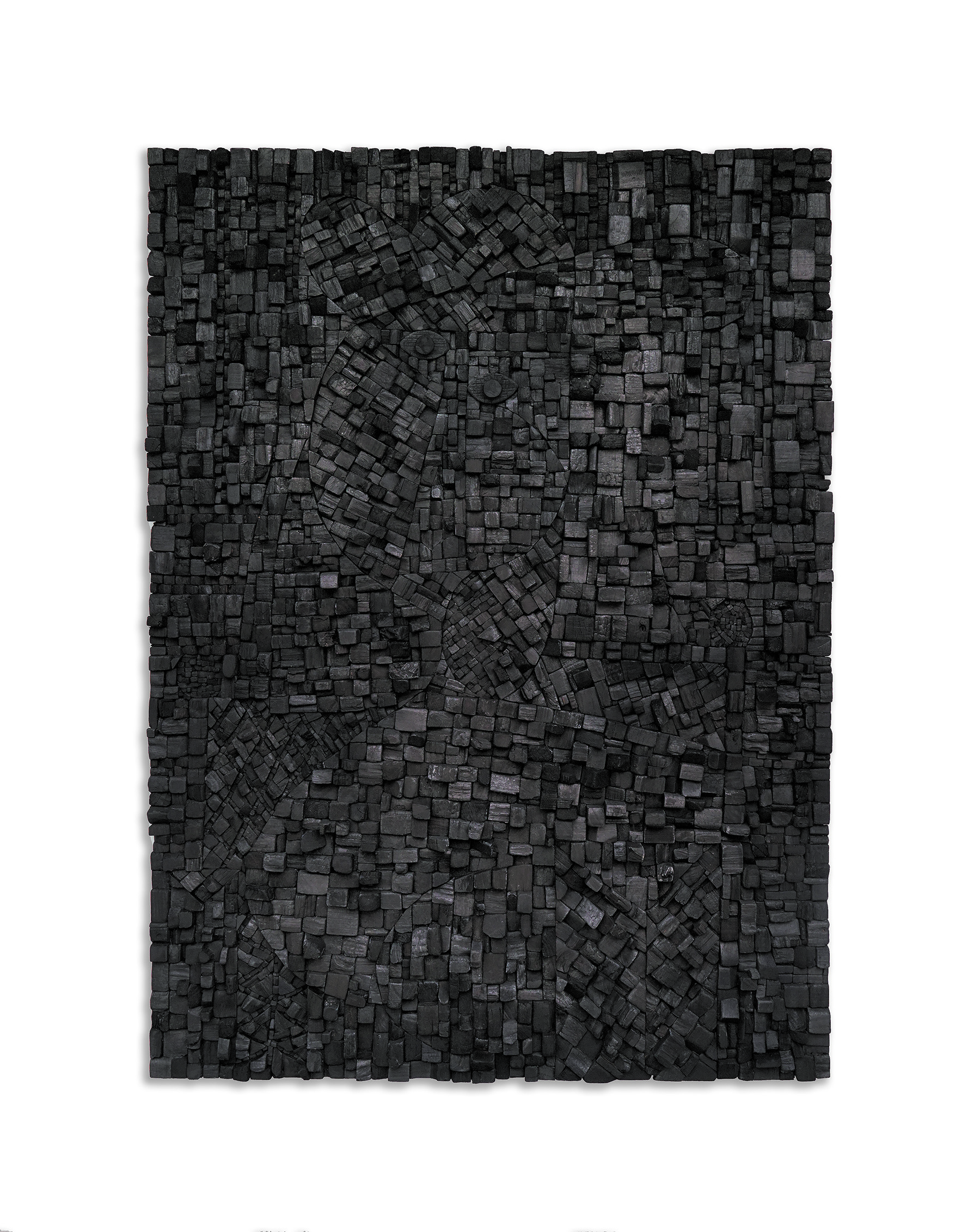
Buste de Femme Au Chapeau Bluebis (2022)
Charcoal block
186 x 120 cm

Femme Au Chapean Col En Fourrure (2022)
Charcoal block
126 x 126 cm

Katarsis (2018)
Charcoal block
ø 142 cm

La Gioconda (2021)
Charcoal block
ø 126 cm
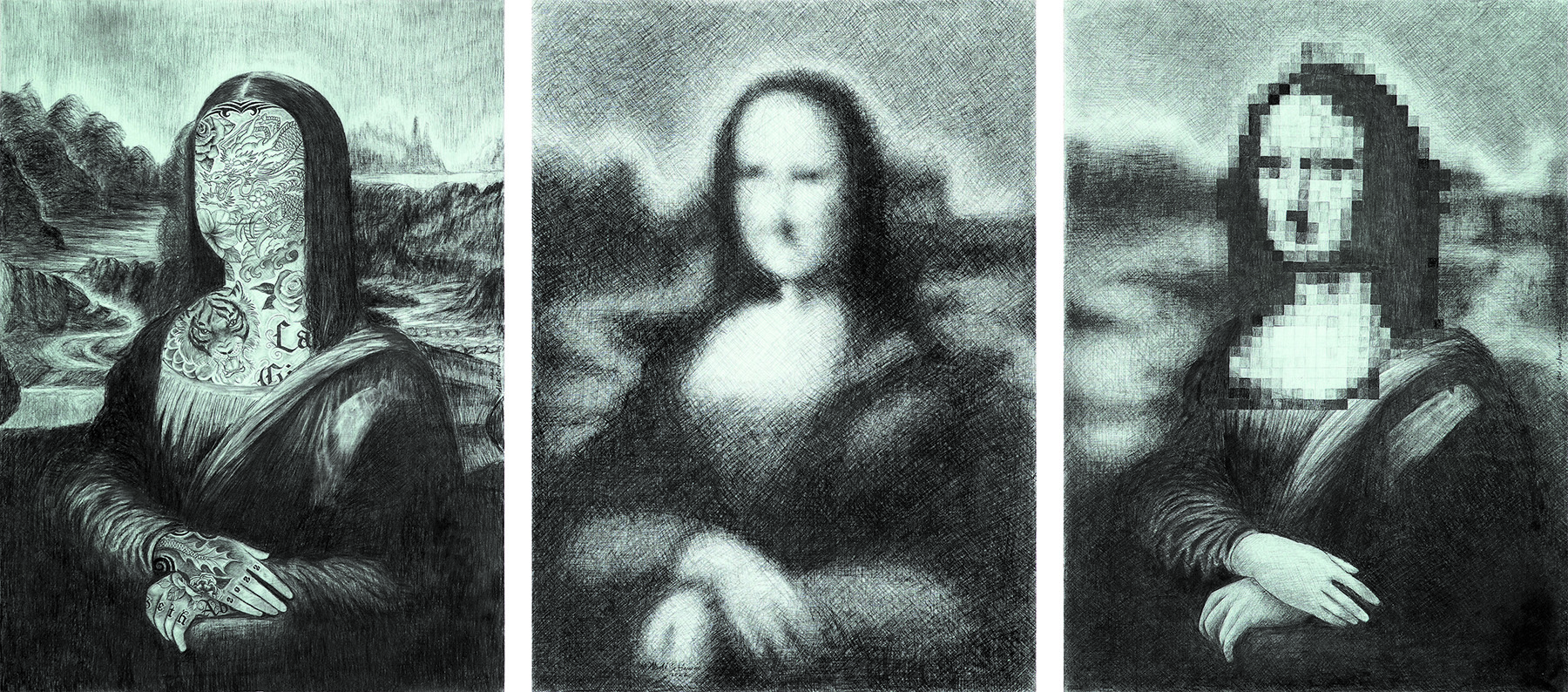
Monalisa (2022)
Charcoal on linen paper
3 panels each: 109 x 79.3 cm

Self Potrait by Van Gogh (2022)
Charcoal block
126 x 126 cm

Starry Night (2020)
Charcoal block
127 x 175 cm

Sun Flower (2018)
Charcoal block
ø 126 cm

Target (2022)
Charcoal block
ø 128 cm
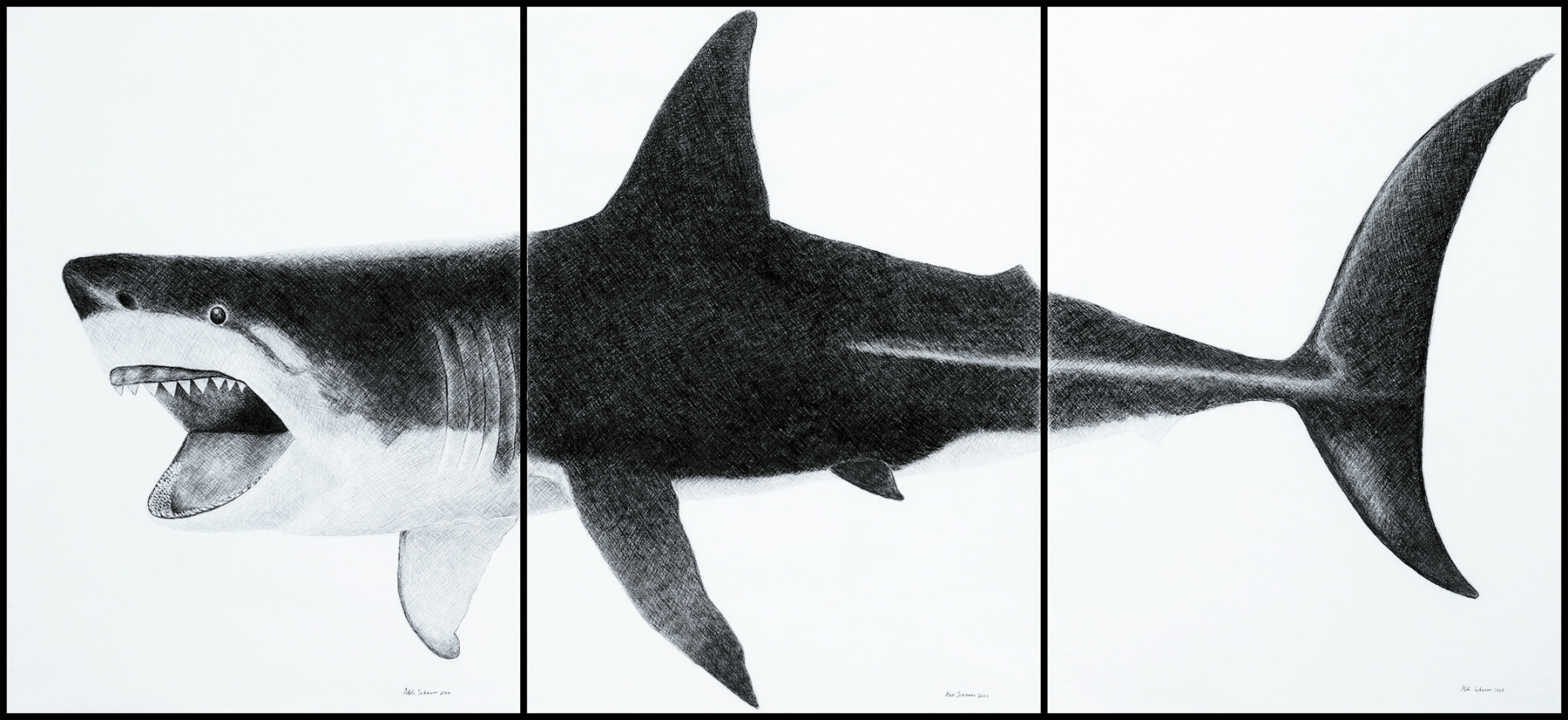
The Immortal (2022)
Charcoal on linen paper
3 panels each: 109 x 79.3 cm

The Persistence of Memory (2020)
Charcoal block
180 x 170 cm (Dimension variable)

Vincent Van Gogh (2020)
Charcoal block
176 x 128 cm